1

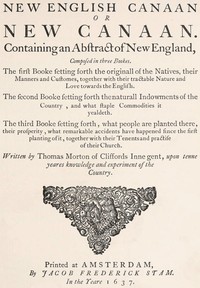
The New English Canaan of Thomas Morton with Introductory Matter and Notes — A Reader’s Guide
(0 User reviews)
235
Project Gutenberg
2017
Not confirmed
Massachusetts -- History -- Colonial period, ca. 1600-1775; New England -- History -- Colonial period, ca. 1600-1775; Massachusetts -- Description and travel -- Early works to 1800; Morton, Thomas, 1575-1646 -- Travel -- New England; Indians of North America -- New England -- History -- 17th century; Indians of North America -- Massachusetts -- History -- 17th century; New England -- Description and travel -- Early works to 1800
Readers of public-domain and historical texts
Project Gutenberg digital edition
en
Edition facts
Words
127,521
Reading time
555 min
Text sections
92
The catalog record for The New English Canaan of Thomas Morton with Introductory Matter and Notes — A Reader’s Guide provides practical reading context through 127,521 words, 9 hr 15 min estimated reading time, and 92 detected text sections.
The text analysis averages about 21.0 words per sentence, while the detected sections provide another way to judge how the source is divided.
Project Gutenberg metadata also associates the work with “Massachusetts -- History -- Colonial period, ca. 1600-1775,” connecting these edition facts with the source record’s subject description.
Source:
Project Gutenberg record #54162
This 1883 edition pairs Thomas Morton's 1637 satirical account of New England with Charles Francis Adams's extensive historical commentary. Morton's vivid, irreverent prose—mocking Puritan leaders and celebrating Native customs—contrasts sharply with Adams's scholarly apparatus, revealing a contested colonial landscape.
Editorial Edition Score
4.9/5
★★★★★
★★★★★
Calculated from edition completeness, EPUB availability, text structure and catalogue metadata. Not a user rating.
How this score is calculated
- Description quality20 pts
- Title & short description10 pts
- Source metadata20 pts
- Text length15 pts
- Chapters / structure15 pts
- EPUB file integrity20 pts
Total of 100 points, scaled to a 2.5-5.0 range. Editions with an empty description or a missing EPUB file are not scored.
Edition quality
Public-domain source text
Read the source text
The source text is kept in the dedicated reader, separate from this catalogue record and its commentary.
Thomas Morton's New English Canaan (1637) is a work of pointed satire disguised as a promotional tract. In this 1883 edition, editor Charles Francis Adams frames Morton as a foil to the Puritan establishment, providing extensive notes that contextualize the author's barbs. The text itself is a three-part structure: an ethnographic survey of Native peoples, a rhapsodic description of the land's abundance, and a polemical history of the Plymouth and Massachusetts Bay colonies. Morton's voice—wry, classical, and deliberately provocative—emerges most vividly in the third book, where he recounts his conflicts with the Pilgrims, whom he dubs the "nine Worthies of New Canaan" and their leader "Captaine Shrimp."
Morton's Classical Frame of Reference
Morton consistently casts his personal struggles in epic terms. When describing his escape from custody at Wessaguscus, he likens his captors to "the Trojans when they had the custody of Hippeus pinetree horse" and himself to the watchful "Geese kept in the Roman Cappitall." This habit of aligning his own actions with classical precedents—while reducing his adversaries to comic figures—runs throughout the narrative. The Puritan captain who pursues him is repeatedly called "Captaine Shrimp," a diminutive that undercuts any claim to authority. Morton's learning is a weapon: he uses it to elevate his own defiance and to mock the pretensions of his opponents.
The Editor's Counterpoint
Charles Francis Adams does not let Morton speak without challenge. In his preface, Adams admits to being an inexperienced editor and notes that the book is "in many respects, a singular book." His annotations supply the historical context that Morton deliberately distorts or omits. For instance, where Morton presents himself as a wronged innocent, Adams's notes draw on court records and other contemporary accounts to reveal a more complicated figure—a trader who antagonized Puritan authorities by selling guns to Native people and erecting a maypole. The editorial apparatus thus becomes a second voice, one that both amplifies and corrects Morton's narrative.
Land, Labor, and the Native Presence
Morton's description of New England's natural abundance in Book II is lush and promotional, but it is also a political argument. By portraying the land as a fertile "Canaan" awaiting English cultivation, he implicitly justifies colonization. Yet his treatment of Native peoples is notably more sympathetic than that of his Puritan contemporaries. In Book I, he describes their customs with ethnographic curiosity, and in the escape episode, a "Salvage" warns him of the approaching posse. This alliance across cultural lines—Morton receiving aid from an Indigenous informant—underscores the complex social landscape of early New England, where allegiances did not always follow the expected colonial divisions.
Readers approaching this edition should attend to the interplay between Morton's seventeenth-century text and Adams's nineteenth-century commentary. The editor's notes are not neutral; they reflect the concerns of the Prince Society, a historical organization dedicated to preserving early American documents. Morton's voice, meanwhile, is anything but objective. Together, they offer a layered portrait of colonial conflict—one in which satire, scholarship, and personal grievance are inextricably tangled.
Thomas Morton’s irreverent voice, tangled up in Adams’s prim footnotes, always felt like a quarrel between two old friends. Strange how that same uneasy companionship finds me again in Narrative of the residence of Fatalla Sayeghir among the wandering Arabs of the great desert — Reading Companion—another record of a stranger’s world, lingering between wonder and the weight of another man’s judgment.
There are no reviews for this eBook.
There are no comments for this eBook.
Reader reflection
Before you leave, reflect on the book
Use these questions to collect your thoughts before moving on.
Your progress
0
/
10
2
What was your overall reaction to the book?
3
Would you recommend this book to another reader?
4
How demanding did the text feel?
5
How strong was your personal connection to the text?
6
How useful did the reading feel?
7
Did the story or argument move comfortably?
8
Did the book offer a fresh perspective?
9
What changed or sharpened your thinking?
10