1

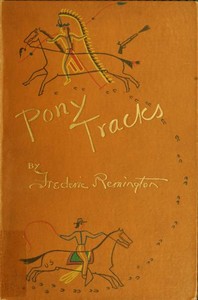
Pony Tracks — Context and Discussion
(0 User reviews)
692
Project Gutenberg
2012
Not confirmed
West (U.S.) -- Description and travel; Frontier and pioneer life -- West (U.S.); Indians of North America -- Wars -- 1866-1895; Remington, Frederic, 1861-1909; Chihuahua (Mexico : State) -- Description and travel
Readers of public-domain and historical texts
Project Gutenberg digital edition
en
Edition facts
Words
54,962
Reading time
239 min
Text sections
7
The source record for Pony Tracks — Context and Discussion measures this digital text at 54,962 words, 3 hr 59 min estimated reading time, and 7 detected text sections.
The text analysis averages about 24.6 words per sentence, while the detected sections provide another way to judge how the source is divided.
Project Gutenberg metadata also associates the work with “West (U.S.) -- Description and travel,” connecting these edition facts with the source record’s subject description.
Source:
Project Gutenberg record #41011
Frederic Remington's firsthand accounts of military campaigns, coaching in Chihuahua, and frontier life, marked by a brisk, observational voice and shifts between action and reflection.
Editorial Edition Score
4.7/5
★★★★★
★★★★★
Calculated from edition completeness, EPUB availability, text structure and catalogue metadata. Not a user rating.
How this score is calculated
- Description quality20 pts
- Title & short description10 pts
- Source metadata20 pts
- Text length15 pts
- Chapters / structure15 pts
- EPUB file integrity20 pts
Total of 100 points, scaled to a 2.5-5.0 range. Editions with an empty description or a missing EPUB file are not scored.
Edition quality
Public-domain source text
Read the source text
The source text is kept in the dedicated reader, separate from this catalogue record and its commentary.
Frederic Remington's Pony Tracks opens with a brisk, first-person account of chasing a Major-General, immediately establishing a voice that is both wry and precise. The narrative moves from the jolt of a five-o'clock wake-up to the sun rising over Fort Keough, setting a pattern of sharp observation and understated humor. Remington's prose is lean, favoring concrete details over embellishment, and his tone shifts subtly between the excitement of the hunt and the mundane realities of travel.
A Voice of Understated Humor
Remington's narrative voice is consistently wry and self-deprecating. In Coaching in Chihuahua, he declares himself a "Jonah in a stage-coach," a claim backed by a litany of accidents: overturned stages, runaway mules, and broken brake-beams. He recounts holding his breath for "five consecutive minutes" during one descent, a hyperbolic detail that underscores his comic tone. This humor is never forced; it emerges naturally from the contrast between his adventurous pursuits and the absurdity of their outcomes. The reader is invited to share in his rueful amusement rather than marvel at his daring.
Pace and the Rhythm of Travel
The pace of Pony Tracks mirrors the journeys it describes: sometimes a slow, dusty crawl, other times a sudden, jarring rush. Remington varies sentence length to match the action. In Chasing a Major-General, short, clipped sentences convey the urgency of the pursuit: "The car had been side-tracked... the porter shook me... I stepped out." Later, in Coaching in Chihuahua, longer, more reflective passages describe the "easy, familiar way" of the coachero with his mules. This rhythmic alternation keeps the reader engaged, shifting between the monotony of travel and the thrill of incident.
Recurring Details of the Frontier
Remington anchors his narratives in specific, recurring details that evoke the frontier. The mules of Chihuahua are "diminutive" and "enduring," trained to "back up against a wall" like bank depositors. The coachero is a giant with "Sullivanesque shoulders" and a "blue-black buccaneer beard." Such descriptions are not mere decoration; they ground the reader in a world where men and animals are shaped by harsh conditions. Remington's eye for the telling detail—the lantern-light on black mules, the "merry brown eye" of the coachman—creates a vivid, tactile sense of place without resorting to romanticism.
Readers approaching Pony Tracks will find a collection that rewards attention to its shifts in tone and tempo. Remington's voice is that of a seasoned observer who knows when to quicken the pace and when to linger on a scene. The book is best read not as a continuous narrative but as a series of distinct episodes, each with its own rhythm. Pay particular attention to the moments of stillness—the description of a lantern-lit stable, the quiet of a mountain camp—as they provide the counterpoint to the action that gives the work its texture.
We were talking about how some books stay with you, and I keep thinking about Remington’s way of moving from dusty action to sudden quiet thought. It feels like how I remember certain winters. There’s another voice that lingers similarly—Flint's Letters from America, 1818-1820 — A Reader’s Guide—so different, yet that same unhurried noticing of a place, without needing to say everything at once.
There are no reviews for this eBook.
There are no comments for this eBook.
Reader reflection
What did you think of this book?
Answer a few questions and save a private reflection on this device.
Your progress
0
/
10
2
How did the book work for you overall?
3
Is this a title you would suggest to others?
4
Did the language feel accessible?
5
How useful did the reading feel?
6
How closely did the book connect with your experience?
7
Did the book deliver what you hoped for?
8
Could you follow the author’s main argument?
9
Which lesson or insight stayed with you?
10