1

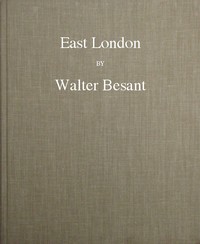
East London — Story, Setting & Ideas
(0 User reviews)
1324
Project Gutenberg
2019
Not confirmed
London (England) -- Social life and customs; Poor -- England -- London; London (England) -- Description and travel; East End (London, England)
Readers of public-domain and historical texts
Project Gutenberg digital edition
en
Edition facts
Words
92,785
Reading time
404 min
Text sections
20
The catalog record for East London — Story, Setting & Ideas provides practical reading context through 92,785 words, 6 hr 44 min estimated reading time, and 20 detected text sections.
The text analysis averages about 26.0 words per sentence, while the detected sections provide another way to judge how the source is divided.
Project Gutenberg metadata also associates the work with “London (England) -- Social life and customs,” connecting these edition facts with the source record’s subject description.
Source:
Project Gutenberg record #58869
Walter Besant's 1901 survey of East London examines its industries, riverside, immigrant communities, and social conditions through detailed observation and interviews, illustrated by Phil May, Joseph Pennell, and L. Raven-Hill.
Editorial Edition Score
4.9/5
★★★★★
★★★★★
Calculated from edition completeness, EPUB availability, text structure and catalogue metadata. Not a user rating.
How this score is calculated
- Description quality20 pts
- Title & short description10 pts
- Source metadata20 pts
- Text length15 pts
- Chapters / structure15 pts
- EPUB file integrity20 pts
Total of 100 points, scaled to a 2.5-5.0 range. Editions with an empty description or a missing EPUB file are not scored.
Edition quality
Public-domain source text
Read the source text
The source text is kept in the dedicated reader, separate from this catalogue record and its commentary.
Walter Besant opens East London not with a historical preamble but with a direct claim: the district is a place of work. The book's first chapter, 'What East London Is,' immediately establishes a contrast with his earlier volumes on Westminster and South London, which required antiquarian treatment. Here, Besant insists that East London must be understood through its present character—its industries, its riverside, its dense populations of immigrants and the poor. The text is structured as a series of topical chapters, each addressing a facet of East End life: 'The City of Many Crafts,' 'The Factory Girl,' 'The Alien,' 'The Houseless,' 'The Submerged.' This organization reflects a methodical, almost sociological approach, yet Besant's voice remains personal, punctuated by encounters with individuals and places.
A Reporter Among the People
Besant's method is that of a roving investigator. He does not simply compile statistics; he seeks out conversations. In the excerpt, he describes an interview with a man over a hundred years old, a former cook for City company banquets and a follower of prize-fights. The old man's refrain—'If I live'—becomes a poignant marker of isolation: he has outlived all his contemporaries. Besant records the detail without moralizing, letting the man's own words convey the weight of extreme age. Elsewhere, he sits in a synagogue on the Sabbath, admitting he does not understand the Hebrew service, yet he interprets the melodies as 'one long, grand hymn of praise and gladness' that explains the people's pride and tenacity. These moments of direct observation, often tinged with the observer's admitted limitations, give the book a texture of lived encounter rather than detached survey.
The City of Many Crafts and Its Workers
The chapter titles themselves map a geography of labor: 'The Pool and the Riverside,' 'The Factory Girl,' 'The Key of the Street.' Besant is attentive to the physical spaces of work—the wharves, the docks, the factories. He notes the survival of the Huguenot silk-weaving tradition in Spitalfields and Bethnal Green, marked by 'wide windows on the first floor' and French names 'rudely Anglicized.' Yet he observes that the French settlement has been 'completely absorbed' into what he calls 'the Anglo-Celtic blend.' The text also registers the presence of a 'colony always changing' in the West India Dock Road, home to Lascars, Arabs, and Malay sailors. These passages accumulate a sense of East London as a place of constant flux, where trades and populations layer over one another, leaving visible traces in architecture and street life.
Contrasts in Worship and Leisure
Besant juxtaposes religious and recreational spaces with a reporter's eye for contrast. The synagogue service, with its ancient melodies supposedly dating to the Exodus, stands against the music halls and bank holidays depicted in later chapters. The illustrations—'In an East End Gin-Shop,' 'A Music-Hall,' 'Sunday Gambling'—reinforce this tension between piety and pastime. Besant does not resolve the contrast; he presents it as part of the district's character. His description of the old man's memories of prize-fights and City banquets hints at a world of rough recreation now passing. The book's structure, moving from 'What East London Is' through crafts, riverside, and social problems to 'Sports and Pastimes' and 'The Helping Hand,' suggests an attempt to hold these disparate elements together in a single, complex portrait.
Readers approaching East London should attend to the interplay between Besant's narrative voice and the visual record provided by the three illustrators. The frontispiece, 'A Street Row in the East End,' and the many drawings of docks, factories, and street scenes are not mere decorations; they extend the text's documentary impulse. Besant's willingness to admit his own ignorance—of Hebrew, of the inner lives of the communities he describes—marks the book as a product of its time, yet his method of patient observation and direct quotation retains a freshness that rewards careful reading.
Flicking back through Besant’s East London, I stopped on his quiet note about the riverside—how the old trades left their trace in the mud long after the bustle moved on. It made me think of another vanished world, the one in The City of the Sacred Well — Background and Themes, where the echoes of a place feel just as heavy, just as tender. Some histories simply wait to be remembered.
There are no reviews for this eBook.
There are no comments for this eBook.
Reader reflection
What was your reading experience?
Capture what you thought, learned, and would like to remember.
Your progress
0
/
10
2
Was reading this book enjoyable?
3
How likely are you to recommend this book?
4
Did the language feel accessible?
5
Was the book what you thought it would be?
6
Could you follow the author’s main argument?
7
How strong was your personal connection to the text?
8
How valuable was this book for your own interests?
9
What changed or sharpened your thinking?
10