1

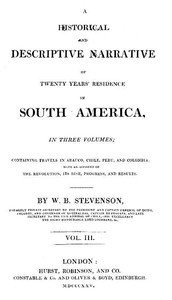
Historical and descriptive narrative of twenty years' residence in South America (Vol 3 of 3) Containing travels in Arauco, Chile, Peru, and Colombia; with an account of the — Reading Notes
(0 User reviews)
73
Project Gutenberg
2017
Not confirmed
Peru -- Description and travel; Peru -- History -- War of Independence, 1820-1829; Ecuador -- Description and travel; Chile -- Description and travel; South America -- History -- Wars of Independence, 1806-1830
Readers of public-domain and historical texts
Project Gutenberg digital edition
en
Edition facts
Words
101,188
Reading time
440 min
Text sections
9
Historical and descriptive narrative of twenty years' residence in South America (Vol 3 of 3) Containing travels in Arauco, Chile, Peru, and Colombia; with an account of the — Reading Notes can be approached with a clearer sense of reading commitment from its source measurements: 101,188 words, 7 hr 20 min estimated reading time, and 9 detected text sections.
The text analysis averages about 37.8 words per sentence, while the detected sections provide another way to judge how the source is divided.
Project Gutenberg metadata also associates the work with “Peru -- Description and travel,” connecting these edition facts with the source record’s subject description.
Source:
Project Gutenberg record #55778
Stevenson's third volume documents the early revolutions in Quito and Lima, then shifts to naval operations under Lord Cochrane. The excerpts reveal a firsthand account of political intrigue, logistical failures, and the author's role as secretary to Cochrane, with detailed complaints about supply shortages and bureaucratic obstruction.
Editorial Edition Score
4.8/5
★★★★★
★★★★★
Calculated from edition completeness, EPUB availability, text structure and catalogue metadata. Not a user rating.
How this score is calculated
- Description quality20 pts
- Title & short description10 pts
- Source metadata20 pts
- Text length15 pts
- Chapters / structure15 pts
- EPUB file integrity20 pts
Total of 100 points, scaled to a 2.5-5.0 range. Editions with an empty description or a missing EPUB file are not scored.
Edition quality
Public-domain source text
Read the source text
The source text is kept in the dedicated reader, separate from this catalogue record and its commentary.
Stevenson's narrative in this third volume moves from the plotting of early revolutionary juntas in Quito to the practical frustrations of naval warfare under Lord Cochrane. The excerpts show a writer who is both a participant and a recorder, blending personal observation with official correspondence. A striking feature is the detailed complaint lodged by Cochrane about the Chilean government's failure to supply rockets and provisions, which Stevenson reproduces at length. This document within the narrative reveals the tension between military ambition and administrative neglect, a theme that recurs throughout the volume.
Revolutionary Beginnings in Quito
The opening chapters trace the first revolutionary symptoms in South America, focusing on Quito. Stevenson introduces figures like Morales and Quiroga, providing character sketches that are both personal and political. The discovery of a plot by Captain Salinas to two friars, and the subsequent imprisonment of the conspirators, is recounted with attention to the mechanics of betrayal and state response. The narrative then follows the formation of a junta, the brief reinstatement of Count Ruis, and the arrival of troops from Lima and Santa Fé. Stevenson's account is grounded in specific names and actions, offering a granular view of how revolutionary sentiment was suppressed and rekindled.
Naval Operations and Supply Failures
A substantial portion of the excerpts is taken up by Lord Cochrane's letter to the Chilean government, which Stevenson includes as evidence of the squadron's struggles. Cochrane complains of broken promises regarding rocket manufacture, exhausted provisions, and orders that limited his ability to seize enemy supplies. He describes taking wine and spirits from Pisco against orders, justifying it as necessity. The letter also details the failure to capture the Spanish frigate la Prueba due to lack of soldiers and the refusal of the government to cooperate. Stevenson's inclusion of this document gives readers direct access to the logistical and political obstacles faced by the patriot navy.
Stevenson's Role and Perspective
Stevenson presents himself as an insider: former private secretary to the President of Quito, governor of Esmeraldas, and secretary to Lord Cochrane. His narrative voice is that of a witness who moves between administrative and military spheres. The excerpts show him recording events in Quito, then shifting to the naval campaign. His perspective is shaped by his proximity to power, yet he does not shy away from documenting failures—such as the capture and escape he mentions in Chapter II. The reader gains a sense of how one individual navigated the shifting allegiances and practical hardships of the independence period.
Readers should approach this volume as a hybrid text: part memoir, part historical record, and part documentary archive. Stevenson's willingness to include official letters and his detailed character sketches offer a textured view of the independence era, but his perspective is necessarily partial. The excerpts suggest a narrative that values specificity over sweeping analysis, making it a useful source for those interested in the day-to-day realities of revolutionary politics and naval warfare in early nineteenth-century South America.
That third volume stayed with me—the way Cochrane’s grand plans kept crumbling under petty shortages, the quiet ache of watching something noble get strangled by red tape. It reminded me of wandering through Flint's Letters from America, 1818-1820 — A Reader’s Guide, where similar hopes meet daily friction. Both feel less like history, more like a friend’s tired, honest letter home.
There are no reviews for this eBook.
There are no comments for this eBook.
Reader reflection
What was your reading experience?
Capture what you thought, learned, and would like to remember.
Your progress
0
/
10
2
Did this book hold your interest?
3
How likely are you to recommend this book?
4
How easy was the book to follow?
5
Which aspect of the book did you value most?
6
How understandable was the text?
7
Would you read this book again?
8
How original did the book feel?
9
What changed or sharpened your thinking?
10