1

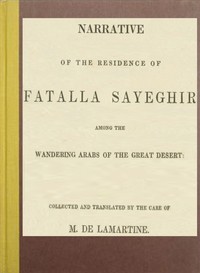
Narrative of the residence of Fatalla Sayeghir among the wandering Arabs of the great desert — Reading Companion
(0 User reviews)
1618
Project Gutenberg
2023
Not confirmed
Arabian Peninsula -- Description and travel
Readers of public-domain and historical texts
Project Gutenberg digital edition
en
Edition facts
Words
57,940
Reading time
252 min
Text sections
11
Before opening Narrative of the residence of Fatalla Sayeghir among the wandering Arabs of the great desert — Reading Companion, the edition data offers a quick orientation: 57,940 words, 4 hr 12 min estimated reading time, and 11 detected text sections.
The text analysis averages about 25.3 words per sentence, while the detected sections provide another way to judge how the source is divided.
Project Gutenberg metadata also associates the work with “Arabian Peninsula -- Description and travel,” connecting these edition facts with the source record’s subject description.
Source:
Project Gutenberg record #72150
This editorial note examines the narrative structure, recurring images of movement and encampment, and the interplay between personal drama and ethnographic observation in Lamartine's account of Fatalla Sayeghir's residence among Bedouin tribes.
Editorial Edition Score
4.8/5
★★★★★
★★★★★
Calculated from edition completeness, EPUB availability, text structure and catalogue metadata. Not a user rating.
How this score is calculated
- Description quality20 pts
- Title & short description10 pts
- Source metadata20 pts
- Text length15 pts
- Chapters / structure15 pts
- EPUB file integrity20 pts
Total of 100 points, scaled to a 2.5-5.0 range. Editions with an empty description or a missing EPUB file are not scored.
Edition quality
Public-domain source text
Read the source text
The source text is kept in the dedicated reader, separate from this catalogue record and its commentary.
The narrative opens not with Fatalla Sayeghir but with Alphonse de Lamartine encamped between Tiberias and Nazareth, reflecting on the "spirit of race" that he sees as the key to understanding Arab tribes. This framing device establishes a layered structure: Lamartine's editorial voice introduces and contextualizes Sayeghir's first-person account. The text moves between broad ethnographic commentary—such as the claim that "races of men form the great secret of history"—and tightly focused personal episodes, like the story of Aloian, Hafza, and Faress. This alternation between general observation and specific incident creates a rhythm that mirrors the nomadic life it describes.
Encampment as Structural Motif
The narrative repeatedly returns to scenes of encampment and departure. Lamartine's introduction places the reader in a camp; later, Aloian's tragedy begins with a charge to escort his family to a new encampment and ends with him finding his mother "seated upon the earth with the two children" unable to pitch the tent alone. The tent is both a domestic space and a marker of social order: its absence signals disruption. When Aloian returns to find his tent missing, the reader understands that his household has been broken. The act of pitching a tent recurs as a practical necessity and a symbol of stability in a world of constant movement.
Movement Across Terrain
Travel across the desert is described with precise, physical detail. Characters move by camel, dromedary, mare, and on foot. Aloian rides "two days" on his black dromedary to reach Faress's tribe; later, he places Hafza on a dromedary that "never paused till they were out of hearing of the camp." The speed and endurance of animals are crucial to the plot. The desert is not a static backdrop but a space traversed with urgency. These journeys are measured in hours and days, not miles, giving the reader a sense of the vastness and the effort required to cross it.
Recurring Images of Violence and Restraint
Violence in the narrative is often sudden and physical, described with stark economy. Aloian separates Faress's "head from his body by a stroke of his sabre." Later, Hafza's father "raised his sabre and laid her at his feet." The sabre appears as an instrument of justice and vengeance. Restraint is also present: Aloian disarms Faress's father, saying it would be "disgraceful to him to kill an old man." These moments of violence are interwoven with codes of honor and shame. The text does not moralize but presents actions as consequences of social rules.
Voice and Narrative Distance
The narrative is filtered through multiple layers: Sayeghir's original account, Lamartine's translation and editing, and the American publishers' preface. Lamartine's introduction uses first-person plural ("We were encamped") and philosophical reflection, while the embedded story of Aloian is told in third person with direct dialogue. This shift in voice creates a sense of immediacy during dramatic scenes. The dialogue is terse and functional: "Where is Hafza?"—"I have neither seen Hafza nor Faress." The contrast between Lamartine's speculative tone and the stark exchanges of the Bedouin characters highlights the cultural distance the narrative attempts to bridge.
Readers should attend to how the narrative moves between scales: from Lamartine's broad theories about race and civilization to the intimate details of a single family's crisis. The excerpts suggest that the work is as much about the act of observing and recording as it is about the events themselves. The desert functions both as a real geography and as a space where social codes are tested and displayed.
There is something of the same patient watchfulness in both—that quiet recording of foreign dust and distant unrest. Lamartine’s companion notes how encampments rise and vanish like thoughts, and I’m reminded of another wanderer, tracking rebellion on foot through Through Bosnia and the Herzegóvina on foot during the insurrection, August and September 1875 — Inside the Classic. Both memoirs hold their authors’ hearts in check, letting the land speak instead.
There are no reviews for this eBook.
There are no comments for this eBook.
Reader reflection
How did this book work for you?
Your answers remain private and are stored only in this browser.
Your progress
0
/
10
2
Did this book hold your interest?
3
Would you recommend this book to another reader?
4
Did the language feel accessible?
5
Did the story or argument move comfortably?
6
Did it raise ideas you would like to talk about?
7
How original did the book feel?
8
Could you follow the author’s main argument?
9
In one sentence, what did you learn?
10