1

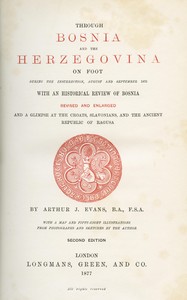
Through Bosnia and the Herzegóvina on foot during the insurrection, August and September 1875 — Inside the Classic
(0 User reviews)
1899
Project Gutenberg
2024
Not confirmed
Bosnia and Herzegovina -- Description and travel; Bosnia and Herzegovina -- History -- Rebellion of 1875
Readers of public-domain and historical texts
Project Gutenberg digital edition
en
Edition facts
Words
168,718
Reading time
734 min
Text sections
35
Before opening Through Bosnia and the Herzegóvina on foot during the insurrection, August and September 1875 — Inside the Classic, the edition data offers a quick orientation: 168,718 words, 12 hr 14 min estimated reading time, and 35 detected text sections.
The text analysis averages about 29.1 words per sentence, while the detected sections provide another way to judge how the source is divided.
Project Gutenberg metadata also associates the work with “Bosnia and Herzegovina -- Description and travel,” connecting these edition facts with the source record’s subject description.
Source:
Project Gutenberg record #73712
Arthur Evans's 1875 account of walking through Bosnia and Herzegovina during the insurrection, blending travelogue with observations on Ottoman rule, local customs, and the landscape, based on his diary entries from August and September.
Editorial Edition Score
4.9/5
★★★★★
★★★★★
Calculated from edition completeness, EPUB availability, text structure and catalogue metadata. Not a user rating.
How this score is calculated
- Description quality20 pts
- Title & short description10 pts
- Source metadata20 pts
- Text length15 pts
- Chapters / structure15 pts
- EPUB file integrity20 pts
Total of 100 points, scaled to a 2.5-5.0 range. Editions with an empty description or a missing EPUB file are not scored.
Edition quality
Public-domain source text
Read the source text
The source text is kept in the dedicated reader, separate from this catalogue record and its commentary.
Arthur Evans begins his narrative not with a declaration of purpose but with a specific, tense scene: raw levies of Bashi Bazouks streaming into a town, beating drums shaped like spoon bowls, and bugle-calls disrupting the night. The author, unarmed and alone, ventures out to sketch an old castle—only to be pelted with stones by a Turkish boy, then confronted by armed adults who shout 'Tursko!' while Evans counters with 'Inglese!' This opening establishes the book's distinctive voice: a blend of antiquarian curiosity, personal indignation, and a Briton's confidence in his nationality's protection, set against the backdrop of a simmering insurrection.
A Traveller's Unflinching Eye
Evans's prose is marked by precise, often wry observations. He notes the Bashi Bazouks' 'antiquated pistols and handshars' and the 'diabolical tattoo' of their drums. When stones fly, he describes the sensation as 'a well-aimed missile—judging by the sensation it produced, larger than any of its predecessors.' The altercation with the boy and his protectors is rendered with a mix of anger and self-deprecating humor: after knocking on the door 'hoping at least to wreak vicarious vengeance,' he recovers from his 'short madness.' These details reveal a narrator who is both a scholar of ruins and a man quick to defend his dignity, offering readers a vivid sense of the daily frictions of travel in a contested region.
Ruins as Witnesses to History
Evans's interest in castles and fortifications is not merely architectural. He describes the castle of Travnik as 'the work of Tvartko, the first King of Bosnia,' linking it to the Christian kingdom that preceded Ottoman rule. He compares it to other 'Starigrads' he has seen, noting their 'polygonal tower' and precarious siting on 'a peninsular rock with ravines on every side.' Yet he also observes that the Turks 'seem still to use it as a kind of arsenal,' showing how a medieval structure is repurposed by the current regime. These passages ground the travelogue in a layered sense of time, where every fortress tells a story of conquest and adaptation.
The Insurrection as a Constant Presence
Though Evans does not describe battles, the insurrection shapes every encounter. The raw levies, the bugle-calls, and the hostility he faces from local Turks all stem from the uprising. His confidence that 'the Bosniac Turks regarded Englishmen' with 'brotherly feelings' is tested repeatedly. The stone-throwing incident is not an isolated annoyance but a symptom of the wider conflict: the boy's protectors assert that 'being a Turk might throw as many stones as he liked at the cursed Giaour.' Evans's response—a box on the ears—is a personal act, but the tension it captures is political. Readers should note how the author's personal safety is never guaranteed, and how the landscape itself is militarized.
Voice and Self-Presentation
Evans writes in the first person, often using 'we' to include his companion L—, but the narrative is dominated by his own actions and reactions. He presents himself as a man of action—sallying forth alone, sketching despite danger, and physically confronting his assailant. Yet he also admits to being 'obtuse in not reading the signs of the times more clearly.' This blend of confidence and self-awareness gives the text a distinctive tone. The excerpts show a writer who is both a product of his imperial era and a keen observer of its contradictions. His use of terms like 'Giaour' and 'Inglese' highlights the ethnic and religious divisions that structure his journey.
Readers approaching this work should attend to the interplay between Evans's personal narrative and the broader historical moment. The insurrection is not a backdrop but a force that shapes every interaction, from the hostile stares to the stones thrown. Evans's voice—scholarly, indignant, and occasionally self-mocking—offers a window into the mindset of a Victorian traveller in a volatile region. The book rewards those who read for both the physical journey and the cultural tensions it exposes.
Some afternoons, when the Balkans settle into a certain slanting light, I think of Evans trudging those dusty tracks, his diary pressed against his ribs. His patience for recording what was vanishing—customs, caravans, a whole way of being—feels kinship with the older wanderers gathered in With the World's Great Travellers, Volume 4 — Background and Themes. They all knew travel was mostly quiet noticing, not arriving. Just witnesses, walking softly through time.
There are no reviews for this eBook.
There are no comments for this eBook.
Reader reflection
What did you think of this book?
Answer a few questions and save a private reflection on this device.
Your progress
0
/
10
2
Did this book hold your interest?
3
Would you pass this book on to a friend?
4
How easy was the book to follow?
5
Did this book create an emotional response?
6
How clear did the writing feel?
7
Was the book what you thought it would be?
8
Would you like to discuss this book with someone?
9
What is the main idea you are taking away?
10