1

France in eighteen hundred and two — Background and Themes
(0 User reviews)
188
Project Gutenberg
2025
Not confirmed
France -- Description and travel
Readers of public-domain and historical texts
Project Gutenberg digital edition
en
Edition facts
Words
127,824
Reading time
556 min
Text sections
54
Before opening France in eighteen hundred and two — Background and Themes, the edition data offers a quick orientation: 127,824 words, 9 hr 16 min estimated reading time, and 54 detected text sections.
The text analysis averages about 22.6 words per sentence, while the detected sections provide another way to judge how the source is divided.
Project Gutenberg metadata also associates the work with “France -- Description and travel,” connecting these edition facts with the source record’s subject description.
Source:
Project Gutenberg record #76267
Henry Redhead Yorke's 1802 letters, edited by J. A. C. Sykes, offer a firsthand account of post-Revolutionary France, detailing encounters with atheist philosophers, a wild boy, and experimental annuity schemes, revealing a nation in flux.
Editorial Edition Score
4.9/5
★★★★★
★★★★★
Calculated from edition completeness, EPUB availability, text structure and catalogue metadata. Not a user rating.
How this score is calculated
- Description quality20 pts
- Title & short description10 pts
- Source metadata20 pts
- Text length15 pts
- Chapters / structure15 pts
- EPUB file integrity20 pts
Total of 100 points, scaled to a 2.5-5.0 range. Editions with an empty description or a missing EPUB file are not scored.
Edition quality
Public-domain source text
Read the source text
The source text is kept in the dedicated reader, separate from this catalogue record and its commentary.
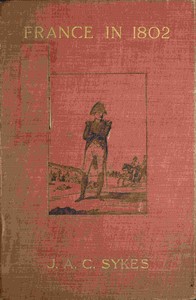
Henry Redhead Yorke's letters from 1802, edited and revised by J. A. C. Sykes, present a traveler's view of France during the Consulate, a period often overshadowed by the Revolution and Empire. The editor's introduction notes that the original work was 'verbose' and has been reduced by about a third, yet the surviving passages retain a sharp, observant tone. Yorke does not simply describe landscapes; he engages with the intellectual currents of the day, recording conversations with 'avowed atheists, members of the National Institute' and detailing their 'subtle sophisms.' His account of a 'wild boy' found in France draws a comparison to Peter the Wild Boy, grounding his observations in contemporary philosophical debates.
Conversations with Philosophers
Yorke's letters are notable for their direct reporting of dialogues with leading thinkers. In one passage, he recounts a discussion with a 'natural philosopher' who describes a project to 'unite an ourang outang to a negro woman'—a scheme proposed by Lagrange and Lacroix. Yorke's tone is critical, calling it 'worthy of the philosophers of the National Institute.' This exchange reveals the tension between Enlightenment rationalism and Yorke's own skepticism. He notes that while these men 'affect to discard everything that is not material,' they still 'soar extra flammentia mœnia mundi,' a phrase that underscores their metaphysical contradictions.
The Wild Boy as a Case Study
Yorke's visit to the 'young savage' leads him to reflect on human nature and society. He applies Dr. Paley's remarks on Peter the Wild Boy to this French counterpart, suggesting a continuity in how 'wild children' were used to test theories of innate versus acquired traits. The letters do not provide the boy's name or detailed physical description, but the encounter serves as a springboard for Yorke to critique the materialist philosophy of his hosts. This section of the correspondence blends travel narrative with philosophical inquiry, showing how a single anecdote can illuminate broader intellectual currents.
Annuity Schemes and Economic Experiments
Yorke devotes considerable attention to a proposed annuity fund, the 'Caisse des Placemens en Viager,' located at 440 Rue Saint Méry. He meticulously outlines its structure: holders are divided into twelve classes, each with a 'progressive annuity' that increases with age, not share value. The motto—'surety, stability, simplicity'—contrasts with the complexity of the system, which involves 'thirty-five gradations' to a maximum of 5000 livres. Yorke compares it to a Tontine but emphasizes the difference: here, 'the probabilities of human life have been calculated' to ensure predictable returns. This detailed financial description reflects the post-Revolutionary interest in rationalizing social welfare.
Editorial Pruning and Historical Context
The editor, J. A. C. Sykes, claims to have reduced the original text by a third, omitting 'nothing of the least importance' while removing verbosity. This editorial intervention shapes the reader's experience, condensing Yorke's observations into a more concise narrative. The introduction by Richard Davey frames the letters as bridging 'the important though little known period which elapsed between the downfall of Robespierre and the Consulate.' Davey argues that the prosperity of modern France is not solely due to the Revolution, a claim that Yorke's letters—with their depictions of philosophical ferment and economic experimentation—both support and complicate.
Readers approaching this edition should note that the letters are filtered through two editorial lenses: Sykes's pruning and Davey's framing. Yorke's voice remains distinctive—curious, critical, and occasionally sardonic—but the selection may emphasize certain themes over others. For those interested in the intellectual and social undercurrents of Consulate France, these letters offer a valuable, if partial, window into a society grappling with its revolutionary past and uncertain future.
I kept thinking about Yorke’s travellers, so sure of their categories, and then I remembered another wanderer, Sayeghir, who let the desert reshape his certainties. Both books carry that quiet ache of watching a world refuse to stay fixed—one in France’s new streets, the other among tents. Narrative of the residence of Fatalla Sayeghir among the wandering Arabs of the great desert — Reading Companion feels like its echo, softer and older.
There are no reviews for this eBook.
There are no comments for this eBook.
Reader reflection
Your personal reading reflection
Build a private reading journal entry for this title.
Your progress
0
/
10
2
How did the book work for you overall?
3
Would you pass this book on to a friend?
4
Did the language feel accessible?
5
Is this a title worth rereading?
6
Would you start a conversation about this book?
7
How clearly were the main ideas presented?
8
Did the book offer a fresh perspective?
9
What is the main idea you are taking away?
10