1

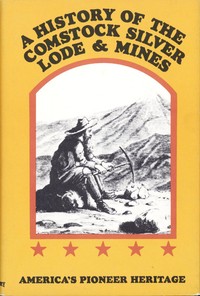
A History of the Comstock Silver Lode & Mines Nevada and the Great Basin Region; Lake Tahoe and the High Sierras — Reading Notes
(0 User reviews)
716
Project Gutenberg
2021
Not confirmed
Silver mines and mining -- Nevada -- History; Comstock Lode (Nev.); Nevada -- Description and travel; Frontier and pioneer life -- Nevada
Readers of public-domain and historical texts
Project Gutenberg digital edition
en
Edition facts
Words
41,740
Reading time
182 min
Text sections
5
Before opening A History of the Comstock Silver Lode & Mines Nevada and the Great Basin Region; Lake Tahoe and the High Sierras — Reading Notes, the edition data offers a quick orientation: 41,740 words, 3 hr 2 min estimated reading time, and 5 detected text sections.
The text analysis averages about 22.3 words per sentence, while the detected sections provide another way to judge how the source is divided.
Project Gutenberg metadata also associates the work with “Silver mines and mining -- Nevada -- History,” connecting these edition facts with the source record’s subject description.
Source:
Project Gutenberg record #64699
Dan De Quille's 1889 guide to the Comstock Lode, Nevada, and the Great Basin region, combining mining history with descriptions of towns, landscapes, and industries, written for tourists and general readers.
Editorial Edition Score
4.7/5
★★★★★
★★★★★
Calculated from edition completeness, EPUB availability, text structure and catalogue metadata. Not a user rating.
How this score is calculated
- Description quality20 pts
- Title & short description10 pts
- Source metadata20 pts
- Text length15 pts
- Chapters / structure15 pts
- EPUB file integrity20 pts
Total of 100 points, scaled to a 2.5-5.0 range. Editions with an empty description or a missing EPUB file are not scored.
Edition quality
Public-domain source text
Read the source text
The source text is kept in the dedicated reader, separate from this catalogue record and its commentary.
Dan De Quille, a Virginia City journalist and author of The Big Bonanza, frames this 1889 work as a concise guide for the visiting tourist, yet it expands into a regional survey of Nevada and the eastern slope of the Sierra Nevada. The book opens by introducing the whole state before narrowing to the Comstock mines, but De Quille explicitly notes that he has "poached very little on the California side," keeping his focus on the Great Basin region. This tension between a narrow mining guide and a broader geographical description shapes the entire text.
A Guide for Tourists, Not Miners
De Quille states plainly that his "central idea" is to give information a tourist would likely require, not a technical manual for miners. Yet the excerpts show detailed descriptions of pumping machinery, shaft depths, and flooding events. The Combination Shaft is described as the deepest vertical opening, with hydraulic pumps at 2,400, 2,600, and 3,000 feet—stations excavated to eighty-five feet long, twenty-eight feet wide, and twelve feet high. The author notes that at the 3,000 level, the spot of daylight at the top appeared "about four inches square," and falling rock whistled "like a rifle-ball." This blend of precise engineering data and vivid, almost sensational imagery suggests De Quille aimed to satisfy both the curious visitor and the armchair reader interested in the dramatic scale of Comstock mining.
The Constant Threat of Water
Water management emerges as a recurring theme. De Quille recounts a February 1882 flood on the 2,700 level of the Exchequer Mine that inundated eleven mines, including the Yellow Jacket, Crown Point, and Belcher. The Yellow Jacket pumps raised 1,320 gallons per minute for seven days, yet the water gained. Pumping continued until March 28, when the water was reduced to 950 feet above the 3,000 level, but then stopped because no combined arrangement could be made among the companies. This episode highlights the interdependence of mines on the lode and the limits of individual company efforts. The author also contrasts the new hydraulic pumps with older Cornish pumps, noting that the hydraulic system used water pressure from the surface, while Cornish pumps required huge steam engines.
Depth and Danger Underground
De Quille repeatedly emphasizes the extreme depths reached on the Comstock. The deepest workings were in the Union Consolidated Mine, where drifts and a winze reached 3,350 feet. The Yellow Jacket shaft had a vertical depth of 3,050 feet. He notes that by connecting shafts with drifts and maintaining ventilation, miners experienced "no difficulty" working at any depth yet attained. But the danger is palpable: a falling rock from the top whistles like a rifle-ball, and a falling man would be "quite 'dissipated.'" The author's tone is matter-of-fact, yet these details convey the physical risks and the almost surreal scale of underground space. The book's structure—moving from state overview to specific mines—mirrors the descent from surface to depth.
Beyond the Mines: The Great Basin Context
Despite the mining focus, De Quille insists that the region east of the Sierra Nevada is "characteristic of the Great Basin," even when technically within California. He mentions Owens River, Independence and Owens Valleys, Owens Lake, and Mono Lake as parts of this region. The book's full title promises coverage of mountains, valleys, lakes, rivers, hot springs, deserts, and other wonders, as well as towns, railways, lumber flumes, and water supply systems. This broader scope suggests that De Quille saw the Comstock not as an isolated phenomenon but as the industrial heart of a distinctive landscape. The tension between the specific lode and the vast basin is central to the work's identity.
De Quille's book is best approached as a period piece that reveals how a late-nineteenth-century writer balanced the demands of a tourist guide with the technical realities of deep mining. Readers interested in the Comstock's engineering feats will find precise details, while those curious about Nevada's regional identity will encounter a deliberate effort to define the Great Basin. The excerpts suggest a work that is neither pure history nor pure description, but a hybrid shaped by its author's dual role as journalist and local expert.
Reading about the Comstock’s ghost towns, I remembered standing alone in a dusty Nevada street, the wind the only sound. That quiet emptiness felt familiar—the same lingering hush I found in Jogging round the world — Key Ideas to Explore, where distant places also whispered of lives once hurried, now still.
There are no reviews for this eBook.
There are no comments for this eBook.
Reader reflection
Before you leave, reflect on the book
Use these questions to collect your thoughts before moving on.
Your progress
0
/
10
2
Did this book hold your interest?
3
Is this a title you would suggest to others?
4
Did the language feel accessible?
5
Would a second reading be valuable?
6
How clearly were the main ideas presented?
7
Did the book deliver what you hoped for?
8
Did the book offer a fresh perspective?
9
Which lesson or insight stayed with you?
10