1

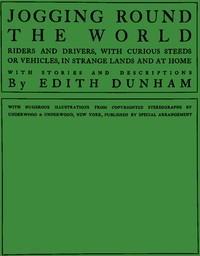
Jogging round the world — Key Ideas to Explore
(0 User reviews)
33
Project Gutenberg
2024
Not confirmed
Voyages and travels -- Juvenile literature; Transportation -- Juvenile literature
Readers of public-domain and historical texts
Project Gutenberg digital edition
en
Edition facts
Words
13,840
Reading time
61 min
Text sections
38
For Jogging round the world — Key Ideas to Explore, the stored edition analysis reports 13,840 words, 1 hr 1 min estimated reading time, and 38 detected text sections.
The text analysis averages about 22.3 words per sentence, while the detected sections provide another way to judge how the source is divided.
Project Gutenberg metadata also associates the work with “Voyages and travels -- Juvenile literature,” connecting these edition facts with the source record’s subject description.
Source:
Project Gutenberg record #73081
A 1905 juvenile geography that pairs stereograph images with descriptions of transportation and daily life across 38 global scenes, from Eskimo sledges to Spanish grape-picking. The text moves through regions by vehicle type, blending travelogue with cultural notes.
Editorial Edition Score
4.7/5
★★★★★
★★★★★
Calculated from edition completeness, EPUB availability, text structure and catalogue metadata. Not a user rating.
How this score is calculated
- Description quality20 pts
- Title & short description10 pts
- Source metadata20 pts
- Text length15 pts
- Chapters / structure15 pts
- EPUB file integrity20 pts
Total of 100 points, scaled to a 2.5-5.0 range. Editions with an empty description or a missing EPUB file are not scored.
Edition quality
Public-domain source text
Read the source text
The source text is kept in the dedicated reader, separate from this catalogue record and its commentary.
Jogging Round the World (1905) by Edith Dunham is structured as a sequence of 38 short vignettes, each anchored to a stereograph image and a specific mode of transport. The book does not follow a continuous narrative but instead hops from region to region—Eskimo sledges, Japanese yama-kagos, Korean unicycles, Philippine carabaos—using the vehicle as a lens into local customs, climate, and daily life. The opening scene, “In the Land of the Eskimos,” immediately establishes this pattern: a description of children playing with a tame bear leads into details about snow houses, whale-blubber lamps, and sledges made of wood, ivory, and reindeer horn. The text consistently moves from the visual (the stereograph) to the explanatory, offering brief cultural or geographical facts without sustained plot or character development.
From Sledge to Palanquin: The Transport as Organizing Principle
The book’s table of contents reads like a global transit log: each entry names a location and a vehicle—The Unicycle of Korea, A Two-Storied Camel Wagon at Agra, Driving a Dog-Team in Holland. This structure means that the reader never stays in one place for long; the journey is lateral, not linear. Dunham uses the vehicle as a hook to draw in young readers, then pivots to local details. For instance, the Korean unicycle entry likely describes the vehicle’s appearance and use before noting the rider’s costume or the streets of Seoul. The same pattern recurs in A Korean Lady in Her Palanquin, where the closed carriage becomes a way to discuss social customs and urban space. The transport is never merely functional—it is a storytelling device that dictates the pace and focus of each section.
Recurring Images: Light, Cold, and Domestic Interiors
Several sensory details recur across geographically distant chapters. In the Eskimo section, the lamp of whale blubber with a dried-turf wick is described as producing a “smoky light” that nevertheless warms the house. Later, in the Dutch dog-team scene, the text may contrast this with the tidy, lamp-lit interiors of Holland. The Eskimo winter home—a dome-shaped house of ice and snow with a passageway—is one of several domestic interiors that Dunham sketches briefly but vividly. Similar attention is given to the Moorish-style houses of Seville, with their marble fountains, orange trees, and narrow streets. These recurring images of home and hearth, whether icy or sunlit, create a subtle thread of comparison: how people adapt their dwellings to climate and available materials.
Movement Between Scenes: The Stereograph as Anchor
Each chapter is explicitly tied to a stereograph image, credited to Underwood & Underwood. The text functions as a caption expanded into a short essay. The opening line of the Eskimo section—“Isn’t this a strange playmate?”—directly addresses the reader as if they are looking at the picture together. This rhetorical strategy appears throughout: the reader is asked to imagine themselves in the scene, to compare their own experience with the unfamiliar. The movement between scenes is abrupt; there is no transition between the frozen Arctic and the old park at Nara. This lack of connective tissue means the book relies on the reader’s willingness to be carried from one stereograph to the next, each a self-contained window onto a different world. The effect is less a journey than a series of snapshots.
Voice and Address: The Implied Reader as Travel Companion
Dunham’s narrator speaks directly to a child reader, using questions (“Would you like to have a bear to play with?”) and inclusive pronouns (“we should like to see them”). The tone is conversational and gently instructive, assuming no prior knowledge. In the Malaga grape-picking scene, the narrator explains how grapes are grown in trenched rows on hillsides, how raisins are dried in the sun, and how olives turn “a dark glossy purple” when ripe. The explanations are simple but precise, grounded in observable detail. The narrator also occasionally points to future reading, as when mentioning Washington Irving’s writings on the Alhambra. This voice positions the book as a friendly guide, not a textbook, and the implied reader is curious, willing to be surprised by a dog-team in Holland or a two-storied camel wagon in Agra.
Because the excerpts cover only the first and last portions of the book, the middle sections—spanning China, India, Egypt, and the Americas—are not represented here. Readers should expect the same pattern: a stereograph image, a vehicle, and a brief cultural sketch. The book’s value lies in its period perspective on global transport and its reliance on visual media to structure knowledge. For a full understanding, the complete sequence of 38 vignettes is necessary.
Sometimes, turning the pages of that old geography, I recall the giddy thrill of movement—sledges, steamers, trains—and it reminds me of another voyage, one measured in salt and solitude. There is a quiet kinship between seeing the world in pictures and feeling it in a sailor’s bones. That, I find, lives in Prentice Mulford's story: life by land and sea — Reading Companion, a gentler sort of travel, remembered rather than shown.
There are no reviews for this eBook.
There are no comments for this eBook.
Reader reflection
How will you remember this book?
Save your reaction, strongest insight, and memorable passage.
Your progress
0
/
10
2
Did this book hold your interest?
3
How likely are you to recommend this book?
4
How demanding did the text feel?
5
Did it raise ideas you would like to talk about?
6
Could you see yourself revisiting this book?
7
How useful did the reading feel?
8
How distinctive were its ideas or approach?
9
What changed or sharpened your thinking?
10