1

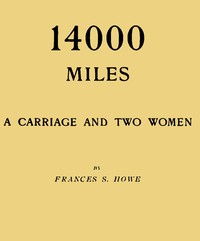
14000 miles, a carriage and two women — Reading Notes
(0 User reviews)
915
Project Gutenberg
2023
Not confirmed
Canada -- Description and travel; New York (State) -- Description and travel; New England -- Description and travel
Readers of public-domain and historical texts
Project Gutenberg digital edition
en
Edition facts
Words
86,375
Reading time
376 min
Text sections
21
Before opening 14000 miles, a carriage and two women — Reading Notes, the edition data offers a quick orientation: 86,375 words, 6 hr 16 min estimated reading time, and 21 detected text sections.
The text analysis averages about 25.0 words per sentence, while the detected sections provide another way to judge how the source is divided.
Project Gutenberg metadata also associates the work with “Canada -- Description and travel,” connecting these edition facts with the source record’s subject description.
Source:
Project Gutenberg record #71527
Frances S. Howe recounts over 14,000 miles of summer and autumn carriage journeys through New England and Canada, originally serialized in newspapers. The narrative blends practical travel details with observations on weather, roads, and the social reception of two women traveling alone, all rendered in a conversational, letter-like style.
Editorial Edition Score
4.9/5
★★★★★
★★★★★
Calculated from edition completeness, EPUB availability, text structure and catalogue metadata. Not a user rating.
How this score is calculated
- Description quality20 pts
- Title & short description10 pts
- Source metadata20 pts
- Text length15 pts
- Chapters / structure15 pts
- EPUB file integrity20 pts
Total of 100 points, scaled to a 2.5-5.0 range. Editions with an empty description or a missing EPUB file are not scored.
Edition quality
Public-domain source text
Read the source text
The source text is kept in the dedicated reader, separate from this catalogue record and its commentary.
Frances S. Howe opens her account of more than 14,000 miles of carriage travel with a direct quotation from a letter she wrote to the Boston Evening Transcript, describing herself and her companion as “a jolly pair, we two, and ladies at that.” This self-aware, slightly defiant tone sets the pattern for the entire work: the author is conscious of the novelty and perceived impropriety of two women driving alone, yet she treats the undertaking with matter-of-fact enthusiasm. The foreword reveals that the book is a compilation of newspaper letters, originally published in the Transcript and later in the Leominster Daily Enterprise, covering an unbroken series of journeys from a first two-hundred-mile trip along the Connecticut River to far longer excursions. The result is a travelogue that feels immediate and episodic, shaped by the rhythms of serial publication rather than by a single retrospective narrative.
A Voice of Practical Defiance
Howe’s prose is marked by a blend of practicality and mild rebellion. She records the “protestations of the towns-people and the remarks of Madam Grundy” that two women traveling alone was neither proper nor prudent, yet she and her companion proceed anyway. This tension between social expectation and personal freedom recurs throughout the excerpts. The author does not dwell on feminist argument; instead, she lets the simple fact of the journey—and her unapologetic reporting of it—carry the point. Her language is direct and unpretentious, as when she notes that they “take our lives in our hands, and ‘do the trip’ in a large comfortable, roomy buggy.” The scare quotes around “do the trip” suggest a wry awareness of how their adventure might be viewed, while the emphasis on comfort and roominess grounds the narrative in tangible, practical concerns.
Weather as a Character
Weather is not merely backdrop in these pages; it is a constant, shaping presence that Howe describes with precision and a touch of humor. She notes “dense fogs along the Connecticut in September” that are “the salvation of vegetation from frosts” but “fatal to views.” Rain turns roads “like rivers,” and a drive can be “one of those ‘cosy’ drives” precisely because it is pouring. The author tracks shifts in weather with the eye of someone who must plan each day’s travel around it: “A new kind of weather was on hand next morning, strangely like that we have become accustomed to, but not so hopeless.” She even coins the term “canned sunshine” for the memory of a bright day stored up against gray ones. This attention to atmospheric detail gives the narrative a sensory immediacy and reveals the author’s intimate knowledge of the landscapes she traverses.
Encounters with People and Places
Howe’s travelogue is populated with brief, vivid encounters. She describes a hotel in Norwich, Vermont, that feels like a private home, with “the fire crackling under the high old mantel” and a “fan-decorated music-room through the portieres.” The “very gallant colored boy” who shows them to a room “the size of the parlor below” is noted without comment, a detail that reflects the casual racial attitudes of the era. Elsewhere, she meets a party of travelers who “declared they had laughed more than if it had been pleasant” despite a ruined Derby hat. These snapshots of fellow travelers and local characters are rendered with a reporter’s eye for the telling detail, but Howe rarely lingers; she moves on, as the journey itself does. The cumulative effect is a mosaic of New England and Canadian life at the turn of the century, seen from the seat of a phaeton.
Structure and Serial Origins
The book’s structure is directly shaped by its origins as a series of newspaper letters. Each chapter covers a distinct journey or season, and the narrative often begins in medias res with a reference to a previous letter or a specific date. The foreword explains that the letters were written “for the Boston Evening Transcript some years ago, and the later letters for the Leominster Daily Enterprise,” and that they “cover an unbroken series of summer and autumn journeys.” This serial format explains the book’s episodic quality: there is no single arc, but rather a repeating pattern of departure, travel, and return. The author occasionally addresses her readers directly, as in the opening quotation, creating a sense of ongoing correspondence. The result is a work that feels less like a polished memoir and more like a collection of dispatches from the road, preserving the spontaneity and immediacy of the original letters.
Readers approaching 14000 Miles, a Carriage and Two Women should expect not a continuous narrative but a series of linked episodes, each with its own weather, roads, and chance encounters. Howe’s voice is consistent—practical, observant, and quietly determined—but the book rewards dipping into individual chapters as much as reading straight through. Pay attention to the small details: the condition of the roads, the quality of the inns, the author’s offhand remarks about social norms. These are the threads that bind the journey together, and they reveal as much about the traveler as about the places she passes through.
There’s a particular peace in reading about someone moving slowly through a landscape, the miles measured in hoofbeats and weather. Frances Howe’s unhurried carriage days brought back the quiet hush of an old summer afternoon. Later, I found the same feeling in this A History of the Comstock Silver Lode & Mines Nevada and the Great Basin Region; Lake Tahoe and the High Sierras — Reading Notes, those dusty miles just sitting there, patient, waiting.
There are no reviews for this eBook.
There are no comments for this eBook.
Reader reflection
How will you remember this book?
Save your reaction, strongest insight, and memorable passage.
Your progress
0
/
10
2
How did the book work for you overall?
3
Would you pass this book on to a friend?
4
How much effort did this book require?
5
Is this a title worth rereading?
6
What did you think about the pace?
7
How distinctive were its ideas or approach?
8
How did the reading compare with what you expected?
9
What is the main idea you are taking away?
10