1

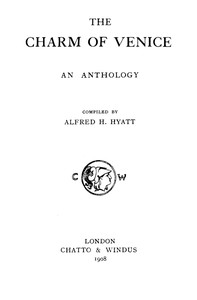
The charm of Venice — A Closer Reading
(0 User reviews)
279
Project Gutenberg
2024
Not confirmed
Venice (Italy) -- Description and travel
Readers of public-domain and historical texts
Project Gutenberg digital edition
en
Edition facts
Words
104,975
Reading time
457 min
Text sections
30
For The charm of Venice — A Closer Reading, the stored edition analysis reports 104,975 words, 7 hr 37 min estimated reading time, and 30 detected text sections.
The text analysis averages about 29.2 words per sentence, while the detected sections provide another way to judge how the source is divided.
Project Gutenberg metadata also associates the work with “Venice (Italy) -- Description and travel,” connecting these edition facts with the source record’s subject description.
Source:
Project Gutenberg record #74272
An anthology of prose and poetry compiled by Alfred H. Hyatt, gathering non-Venetian writers' eulogies to Venice. Excerpts show vivid descriptions of lagoon sunsets, Lido excursions, and the city's unique light, with contributors including John Addington Symonds and others.
Editorial Edition Score
4.9/5
★★★★★
★★★★★
Calculated from edition completeness, EPUB availability, text structure and catalogue metadata. Not a user rating.
How this score is calculated
- Description quality20 pts
- Title & short description10 pts
- Source metadata20 pts
- Text length15 pts
- Chapters / structure15 pts
- EPUB file integrity20 pts
Total of 100 points, scaled to a 2.5-5.0 range. Editions with an empty description or a missing EPUB file are not scored.
Edition quality
Public-domain source text
Read the source text
The source text is kept in the dedicated reader, separate from this catalogue record and its commentary.
Alfred H. Hyatt’s The Charm of Venice (1908) is an anthology that collects impressions of the city from non-Venetian writers, as Hyatt explains in his editor’s note: “Of the beauty of Venice members of every nation have written, and perhaps in a greater measure than the Venetians themselves.” The excerpts reveal a focus on sensory experience—light, color, and atmosphere—rather than historical narrative. John Addington Symonds’s description of a sunset from Torcello, for instance, traces “the ruddy arches overhead reflected without interruption in the waveless ruddy lake below,” while another passage details the Lido’s “old-world quiet, leafy shade” and its views toward the Alps. The anthology’s structure, moving from general praise to specific locales, suggests a deliberate arrangement of perspectives.
A Symphony of Light and Color
The excerpts repeatedly foreground Venice as a visual phenomenon, particularly its skies and lagoons. Symonds’s passage on Venetian sunsets catalogues a range of effects: after wet stormy days, “chasms of clear turquoise heavens emerge, and horns of flame are flashed to the zenith”; on fair evenings, “the skies are woven over with a web of half-transparent cirrus-clouds” that blush crimson. The language is precise about hues—lilac, rose, purple, green, lemon—and about the interplay of light and water. Symonds notes that “the far reaches of the lagoons, the Alps, and islands assume those tones of glowing lilac which are the supreme beauty of Venetian evening.” Yet he also values quieter moments: “the lagoons, painted in monochrome of greys, with just one touch of pink upon a western cloud.” This attention to variety suggests that the anthology’s charm lies not in a single ideal view but in the city’s capacity to transform under different weather and times of day.
The Lido as a Place of Contrasts
The Lido excerpt presents two contrasting points of approach: San Nicoletto, with its “old-world quiet, leafy shade” and prospect through islands to snow-touched peaks, versus Sant’ Elisabetta, which offers “glare and bustle and extended view of Venice.” The former is described as a former fashionable resort, now chosen by artists for its quiet; the latter is associated with modern pleasures: “a plunge into the Adriatic, or a stroll along smooth sands, or a breath of genuine sea-breeze, or a handful of horned poppies from the dunes.” This juxtaposition hints at a tension between past and present, solitude and sociability, that may run through the anthology. The Lido is not merely a beach but a site where different modes of experiencing Venice—contemplative versus active—are set side by side. The mention of “horned poppies” and “acacia-trees” grounds the description in specific flora, avoiding generic praise.
The Anthology’s Composition and Scope
Hyatt’s editorial note and acknowledgments reveal the anthology’s method: it gathers “prose passages and poems that paint in a few words some of the varied charms belonging to Venice.” The acknowledgments list a range of contributors—including Lady Ritchie, Arthur Symons, Gabriele D’Annunzio, and Vernon Lee—and publishers such as Chatto & Windus, Macmillan, and Duckworth. The excerpts suggest a bias toward late 19th- and early 20th-century British and American writers, with a few Italian and French figures. The anthology’s organization is not evident from the excerpts alone, but the inclusion of both poetry and prose, and of works by both well-known and obscure authors, indicates an effort to present a multifaceted portrait. The focus on “charm” rather than systematic history or guidebook information positions the collection as a literary companion for those already acquainted with Venice.
Readers approaching Hyatt’s anthology should expect a series of vignettes rather than a continuous narrative. The excerpts reward attention to the writers’ differing styles—Symonds’s elaborate color descriptions contrast with the more direct observations of the Lido passage. Because the anthology draws on multiple authors, its unity comes from the shared subject rather than a single voice. This makes it suitable for browsing, perhaps starting with a section that matches one’s own experience of Venice, whether at sunset or on a quiet afternoon.
I kept thinking about that Venice anthology, how its writers chased a light that slips away the moment you name it. It reminded me of another city’s quiet pull, Constantinople’s own layered glow. There’s something tender in how both places ask you to look twice. Constantinople old and new — Key Ideas to Explore lingered beside it, like an old photograph found in a drawer.
There are no reviews for this eBook.
There are no comments for this eBook.
Reader reflection
How did this book work for you?
Your answers remain private and are stored only in this browser.
Your progress
0
/
10
2
What was your overall reaction to the book?
3
Would you encourage someone else to read it?
4
Did the language feel accessible?
5
Is this a title worth rereading?
6
How clear did the writing feel?
7
Did the book meet your expectations?
8
Did the story or argument move comfortably?
9
Which lesson or insight stayed with you?
10