1

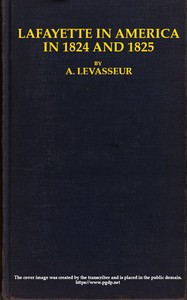
Lafayette in America in 1824 and 1825, Vol. 2 (of 2) Or, Journal of a Voyage to the United States — Reading Companion
(0 User reviews)
612
Project Gutenberg
2020
Not confirmed
United States -- Description and travel; United States -- Social life and customs -- 19th century; United States -- Relations -- France; France -- Relations -- United States; Lafayette, Marie Joseph Paul Yves Roch Gilbert Du Motier, marquis de, 1757-1834 -- Travel -- United States; Lafayette, Marie Joseph Paul Yves Roch Gilbert Du Motier, marquis de, 1757-1834 -- Friends and associates; Levasseur, Auguste, 1795-1878 -- Diaries; Levasseur, Auguste, 1795-1878 -- Travel -- United States; United States -- History -- Revolution, 1775-1783 -- Anniversaries, etc.
Readers of public-domain and historical texts
Project Gutenberg digital edition
en
Edition facts
Words
105,992
Reading time
461 min
Text sections
19
The source record for Lafayette in America in 1824 and 1825, Vol. 2 (of 2) Or, Journal of a Voyage to the United States — Reading Companion measures this digital text at 105,992 words, 7 hr 41 min estimated reading time, and 19 detected text sections.
The text analysis averages about 30.6 words per sentence, while the detected sections provide another way to judge how the source is divided.
Project Gutenberg metadata also associates the work with “United States -- Description and travel,” connecting these edition facts with the source record’s subject description.
Source:
Project Gutenberg record #61778
Auguste Levasseur's journal of Lafayette's 1824–1825 American tour captures encounters with a free Black woman married to a Creek warrior, a former slave who helped build Fort Chartres, and the contrast between Revolutionary memory and contemporary American society.
Editorial Edition Score
4.8/5
★★★★★
★★★★★
Calculated from edition completeness, EPUB availability, text structure and catalogue metadata. Not a user rating.
How this score is calculated
- Description quality20 pts
- Title & short description10 pts
- Source metadata20 pts
- Text length15 pts
- Chapters / structure15 pts
- EPUB file integrity20 pts
Total of 100 points, scaled to a 2.5-5.0 range. Editions with an empty description or a missing EPUB file are not scored.
Edition quality
Public-domain source text
Read the source text
The source text is kept in the dedicated reader, separate from this catalogue record and its commentary.
Auguste Levasseur, Lafayette's secretary, recorded the general's triumphal return tour through the United States in 1824–1825. This second volume follows the party from Washington into the Deep South and the Mississippi Valley. Levasseur's journal is not a mere itinerary; it is a layered observation of a nation in flux, where Revolutionary memory collides with the realities of slavery, Indian removal, and regional identity. The text's most striking passages emerge not from official ceremonies but from unexpected encounters—with a free Black woman married to a Creek warrior, with an aged former slave who helped build Fort Chartres, and with the complex social hierarchies of the frontier. These moments reveal tensions that official celebrations could not contain.
A Free Woman's Pride and the Limits of Hospitality
Near Kaskaskia, Levasseur meets Mary, a free Black woman who had left her white benefactors to marry Sciakape, a Creek warrior. She recounts her choice with "a degree of pride" that suggests she anticipates judgment. Her story is embedded in a web of relationships: her adopted father serves on Lafayette's reception committee, and her adopted mother asks Levasseur to escort Mary to the ball. The scene is remarkable for its casual integration of racial and cultural boundaries—Mary moves between the Mesnard household and her Creek encampment, and the French-descended family treats her with affection. Yet Levasseur's own surprise at her pride hints at the assumptions he brought with him. The passage offers a rare glimpse of a woman navigating multiple worlds, her agency visible despite the constraints of the era.
The Voice of the Old Negro and the Ruins of Fort Chartres
In the same kitchen, Levasseur encounters an aged enslaved man, so wrinkled that he can barely be seen. When the man hears of Mr. Choteau, he erupts with a voice that seems too strong for his body: "What! you found the little Choteau?" He recalls rowing against the Mississippi's current to build Fort Chartres when Choteau was seventeen. The fort, he says, was built to outlast everyone, "and yet I have seen the last of it; for it is now in ruins, and I am yet living." The man cannot count his own years—"they never taught me to count"—but he measures time by the fort's decay and his own survival. Levasseur does not moralize; he lets the man's words stand. The contrast between the monumental fort and the living witness, between official history and personal memory, is stark.
Translating a Nation: Levasseur's Documentary Impulse
Levasseur's journal is shaped by his role as secretary and translator. He records speeches, toasts, and ceremonies, but he also transcribes the voices of those outside the official narrative. The encounter with Mary and the old man are set pieces within a larger travelogue that includes cattle shows, Indian deputations, and congressional honors. Levasseur's attention to detail—the "black mass" in the corner, the "little cloud of tobacco-smoke"—suggests a documentary impulse that goes beyond celebration. He is curious about the social fabric, not just the pageantry. The translator, John D. Godman, a physician and naturalist, brings his own precision to the English text. Together, author and translator produce a work that functions as both a record of Lafayette's tour and a cross-section of American life in the 1820s.
Readers should approach this volume as a primary source that rewards attention to incidental detail. Levasseur's position—French, educated, loyal to Lafayette—shapes what he sees and records. The journal's value lies not only in its account of the tour but in the voices it preserves: Mary's pride, the old man's memory, the casual hierarchies of the frontier. To read it is to watch a foreign observer trying to make sense of a country that is itself trying to make sense of its past and future.
Reading about that free Black woman beside a Creek warrior, I remembered my grandmother’s quiet pride in our own mixed lineage—a complexity history rarely records. It felt like the hushed reverence I once had over Constantinople old and new — Key Ideas to Explore, where layers of empire and faith sat uneasily together, each asking to be remembered without being simplified. Some stories simply wait for us to listen slowly.
There are no reviews for this eBook.
There are no comments for this eBook.
Reader reflection
Take a moment to reflect on this book
Create a short personal record of your experience with this book.
Your progress
0
/
10
2
How much did you enjoy the reading experience?
3
How likely are you to recommend this book?
4
Did the language feel accessible?
5
Did the book give you something worth debating?
6
How strongly did the book affect you emotionally?
7
Did the book meet your expectations?
8
How clear did the writing feel?
9
What changed or sharpened your thinking?
10