1

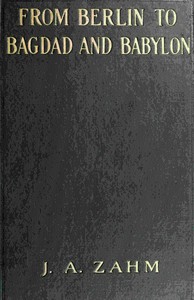
From Berlin to Bagdad and Babylon — Inside the Classic
(0 User reviews)
517
Project Gutenberg
2024
Not confirmed
Middle East -- Description and travel; Middle East -- Civilization
Readers of public-domain and historical texts
Project Gutenberg digital edition
en
Edition facts
Words
185,733
Reading time
808 min
Text sections
44
This digital edition of From Berlin to Bagdad and Babylon — Inside the Classic is described by source-level measurements including 185,733 words, 13 hr 28 min estimated reading time, and 44 detected text sections.
The text analysis averages about 27.3 words per sentence, while the detected sections provide another way to judge how the source is divided.
Project Gutenberg metadata also associates the work with “Middle East -- Description and travel,” connecting these edition facts with the source record’s subject description.
Source:
Project Gutenberg record #74176
A travelogue tracing a journey from Berlin to Baghdad and Babylon, blending observations of landscapes, ancient ruins, and Christian communities with reflections on history and religion.
Editorial Edition Score
4.9/5
★★★★★
★★★★★
Calculated from edition completeness, EPUB availability, text structure and catalogue metadata. Not a user rating.
How this score is calculated
- Description quality20 pts
- Title & short description10 pts
- Source metadata20 pts
- Text length15 pts
- Chapters / structure15 pts
- EPUB file integrity20 pts
Total of 100 points, scaled to a 2.5-5.0 range. Editions with an empty description or a missing EPUB file are not scored.
Edition quality
Public-domain source text
Read the source text
The source text is kept in the dedicated reader, separate from this catalogue record and its commentary.
The narrative begins in Berlin and moves eastward, following a route shaped by centuries of migration and military campaigns. Zahm writes as a student rather than a tourist, noting the crumbling remains of once-great capitals and the living traditions of Eastern Christian churches. The journey is structured as a series of movements between cities and ruins, with recurring attention to the physical traces of history—walls, monasteries, and liturgical languages.
Movement as Method
The book’s structure is defined by the author’s eastward progress, each chapter marking a new stage from Berlin to the Tigris. Zahm frames this movement as a retracing of ancient migrations and military marches, from Asurbanipal to the Crusades. The journey is not merely geographical but temporal: the traveler moves through layers of civilization, where the present landscape is punctuated by remnants of the past. The author’s attention to the route itself—the roads, rivers, and passes—gives the narrative a sense of continuous motion, as if the reader is traveling alongside him.
Ruins and Remains
Throughout the excerpts, Zahm pauses to describe physical remains: the crumbling walls of Babylon, the monastery of St. Mary of Kanobin, and the churches of Malabar. These sites are not merely described but interpreted as evidence of historical change. The author notes how the Maronite Patriarchs have found their last resting place in the Lebanon monastery, and how the Malabar Christians preserve a “Rite of Malabar” distinct from Roman liturgy. The recurring image of ruins—especially those of once-great capitals—serves as a visual anchor for the book’s reflections on the rise and fall of empires.
Christian Communities in Transit
Zahm devotes considerable attention to the Eastern Christian churches he encounters, particularly the Maronites and Malabar Christians. He traces their origins, schisms, and liturgies, noting how they have preserved their rites despite centuries of oppression. The Maronites, he writes, constitute almost the entire population of the Lebanon, and their liturgy is performed in Syriac or Arabic written in Syriac characters. The Malabar Christians, once Nestorians, are now mostly in communion with Rome. These communities are presented as living remnants of early Christian diversity, their persistence a counterpoint to the ruins of pagan empires.
Theological Threads
Interwoven with the travel narrative are discussions of theological disputes, such as Monophysitism and Nestorianism. Zahm explains how national loyalties and misunderstandings contributed to schisms, using the example of Egypt’s embrace of Monophysitism under Dioscur. The author’s tone is analytical, not polemical, as he examines the causes of separation from Rome. These passages shift the book’s focus from landscape to doctrine, suggesting that the journey is also an intellectual exploration of faith and history. The recurring question—why these churches have clung to their rites for over fourteen centuries—ties the travelogue to a broader inquiry into religious identity.
Readers should approach this work as a hybrid: part travel diary, part ecclesiastical history. The author’s observations are grounded in specific sites and communities, but his broader reflections on empire, religion, and cultural persistence give the narrative a scholarly weight. The journey from Berlin to Babylon is both literal and metaphorical, tracing the arc of civilizations through their material and spiritual remains.
There is something about traveling east, watching the light change over ancient stones, that makes you feel the weight of every mile. I used to linger over that old Berlin-to-Baghdad record the way one lingers over a familiar photograph. It makes me think of the quieter warmth in A summer journey to Brazil — Key Ideas to Explore, where the heat feels less like history and more like sunlight.
There are no reviews for this eBook.
There are no comments for this eBook.
Reader reflection
Your personal reading reflection
Build a private reading journal entry for this title.
Your progress
0
/
10
2
How much did you enjoy the reading experience?
3
How likely are you to recommend this book?
4
How easy was the book to follow?
5
How strong was your personal connection to the text?
6
What was its emotional impact?
7
How valuable was this book for your own interests?
8
What did you appreciate most?
9
What changed or sharpened your thinking?
10