1

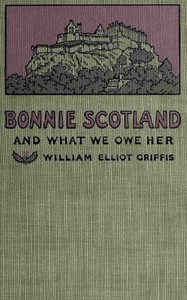
Bonnie Scotland and what we owe her — Text and Context
(0 User reviews)
2201
Project Gutenberg
2023
Not confirmed
Scotland -- Description and travel; Scotland
Readers of public-domain and historical texts
Project Gutenberg digital edition
en
Edition facts
Words
69,895
Reading time
304 min
Text sections
34
The source record for Bonnie Scotland and what we owe her — Text and Context measures this digital text at 69,895 words, 5 hr 4 min estimated reading time, and 34 detected text sections.
The text analysis averages about 21.1 words per sentence, while the detected sections provide another way to judge how the source is divided.
Project Gutenberg metadata also associates the work with “Scotland -- Description and travel,” connecting these edition facts with the source record’s subject description.
Source:
Project Gutenberg record #71578
Griffis draws on eight journeys to Scotland to examine the nation's landscapes, history, and character, focusing on the contrast between Highland romance and modern Lowland industry, and the enduring cultural debt owed by America.
Editorial Edition Score
4.9/5
★★★★★
★★★★★
Calculated from edition completeness, EPUB availability, text structure and catalogue metadata. Not a user rating.
How this score is calculated
- Description quality20 pts
- Title & short description10 pts
- Source metadata20 pts
- Text length15 pts
- Chapters / structure15 pts
- EPUB file integrity20 pts
Total of 100 points, scaled to a 2.5-5.0 range. Editions with an empty description or a missing EPUB file are not scored.
Edition quality
Public-domain source text
Read the source text
The source text is kept in the dedicated reader, separate from this catalogue record and its commentary.
Griffis opens his account of Scotland not with a sweeping panorama but with a specific, personal method: eight journeys, five alone and three with companions, on foot and by various vehicles, through Highlands and Lowlands. The preface foregrounds the Scottish home and hospitality as the most memorable feature, while the book itself attempts to reckon with what Americans owe to Scotland. This is not a detached survey; Griffis writes as a traveler who has stayed long and often, and his observations are grounded in repeated visits rather than a single tour.
The Spell of the Invisible
The first chapter title, “The Spell of the Invisible,” signals Griffis’s interest in what persists beyond stone and brass. In the excerpt on Inverness, he notes that the Highland dress of a century ago was vastly different from the silk and wool sold in modern shops—a contrast between authentic but squalid fabrics and later commercial luxury. He also observes that Inverness had no wheeled vehicle or turnpike road within forty miles, yet the town had contact by sea with France. This juxtaposition of isolation and foreign influence recurs throughout the text. Griffis is attentive to material details: the only dwelling with a room without a bed, the quality of hotel tea, the low sweet voice of the maid. These small observations anchor his larger reflections on change and continuity.
The Jacobite Afterlife
Griffis devotes a full chapter to Bonnie Prince Charlie, whom he calls the figure that “still acts powerfully upon the tradition, literature, and imagination of Scotland.” He emphasizes the gap between the romantic image—the fair youth in full splendor—and the historical reality of the “wretched dregs” of the later years. The excerpt describes how, after Culloden, the victor found provisions prepared for the Highlanders and Jacobite ladies who had been preparing for a ball. The abrupt reversal from celebration to flight is rendered with quiet irony. Griffis also notes that the remnant of English Jacobites still drinks to the Stuarts annually in London and Philadelphia, showing how the lost cause persists in ritual. The songs “Come o’er the stream, Charlie” and “The White Cockade” are still sung, and old women in Highland glens invite the prince to return. Griffis treats this not as mere nostalgia but as a living cultural force.
Traveler’s Method and American Debt
Griffis structures his narrative around his own movements: he visits Glasgow, Edinburgh, Melrose Abbey, the Border, Dunfermline, Dundee, and Inverness, among other places. His method is to combine personal anecdote with historical digression. In Inverness, he notes the absence of hosts to invite him for tea, so he relies on hotel service, but he praises the decoction and the maid’s voice. This blend of the mundane and the historical is characteristic. The book’s subtitle, “What We Owe Her,” frames the entire project as an accounting of American cultural debt. Griffis does not list specific debts in the excerpts, but the preface promises to tell of “the Scotsman at home and abroad, his part in the world’s work.” The reader is invited to follow a traveler who is both a historian and a grateful guest.
Griffis’s Scotland is a land of layered contrasts: between Highland romance and Lowland industry, between the squalor of old plaids and the luxury of modern shops, between the living tradition of Jacobite songs and the vanished world of feudal Scotland. His personal journeys provide the thread, but the book’s real subject is the invisible spell that persists through change. Readers will find a work that is part travelogue, part cultural history, and part personal tribute—one that rewards attention to its small, precise observations.
I kept thinking about how Griffis sees Scotland twice—once through romantic Highland mist, once through gritty Lowland mills—and how both are true. That tension stayed with me. Then I found myself in Recollections of full years — Inside the Classic, where the same double vision applies to a life: the polished story, the quieter truth underneath. Some books just hold that space open for you, gently, long after you close them.
There are no reviews for this eBook.
There are no comments for this eBook.
Reader reflection
Your personal reading reflection
Build a private reading journal entry for this title.
Your progress
0
/
10
2
How did the book work for you overall?
3
Would you encourage someone else to read it?
4
How easy was the book to follow?
5
What did you think about the pace?
6
How distinctive were its ideas or approach?
7
How valuable was this book for your own interests?
8
Did you relate to its people, ideas, or situations?
9
What is the main idea you are taking away?
10