1

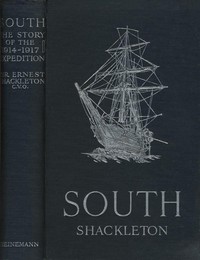
South: The Story of Shackleton's Last Expedition, 1914-1917 — Text and Context
(0 User reviews)
322
Project Gutenberg
2004
Not confirmed
Shackleton, Ernest Henry, Sir, 1874-1922 -- Travel -- Antarctica; Imperial Trans-Antarctic Expedition (1914-1917); Antarctica -- Discovery and exploration -- British; Endurance (Ship)
Readers of public-domain and historical texts
Project Gutenberg digital edition
en
Edition facts
Words
152,679
Reading time
664 min
Text sections
28
Before opening South: The Story of Shackleton's Last Expedition, 1914-1917 — Text and Context, the edition data offers a quick orientation: 152,679 words, 11 hr 4 min estimated reading time, and 28 detected text sections.
The text analysis averages about 19.1 words per sentence, while the detected sections provide another way to judge how the source is divided.
Project Gutenberg metadata also associates the work with “Shackleton, Ernest Henry, Sir, 1874-1922 -- Travel -- Antarctica,” connecting these edition facts with the source record’s subject description.
Source:
Project Gutenberg record #5199
Shackleton's account of the Imperial Trans-Antarctic Expedition, focusing on the loss of the Endurance, the crew's survival on ice, and the open-boat journey to South Georgia, with precise details of rationing, decision-making, and physical endurance.
Editorial Edition Score
4.9/5
★★★★★
★★★★★
Calculated from edition completeness, EPUB availability, text structure and catalogue metadata. Not a user rating.
How this score is calculated
- Description quality20 pts
- Title & short description10 pts
- Source metadata20 pts
- Text length15 pts
- Chapters / structure15 pts
- EPUB file integrity20 pts
Total of 100 points, scaled to a 2.5-5.0 range. Editions with an empty description or a missing EPUB file are not scored.
Edition quality
Public-domain source text
Read the source text
The source text is kept in the dedicated reader, separate from this catalogue record and its commentary.
Shackleton opens his narrative not with the departure from England but with the ship Endurance already beset in the Weddell Sea pack ice. The reader is immediately placed in a world where the vessel is a stationary platform, the ice a moving landscape. The text is punctuated by precise measurements—distances in miles, weights in pounds, temperatures in degrees—that ground the extraordinary in the factual. The crew's daily routines, from dog training to scientific observations, are recorded alongside the growing pressure ridges that threaten the ship. This is not a romantic adventure but a log of incremental crisis, where each decision about food, fuel, and route carries life-or-death weight.
The Calculus of Survival
Throughout the excerpts, Shackleton repeatedly quantifies resources: rations for ten more days, fourteen-pound albatrosses, six pounds of meat per bird after dressing. These numbers are not incidental; they form the backbone of every strategic choice. When the Endurance is lost, the narrative shifts from exploration to a sustained logistical problem. The men calculate how many days a seal carcass will feed them, how much blubber is needed for fuel, and whether to risk a boat journey or wait on the ice. The text reveals a commander who thinks in terms of margins—of time, weight, and distance. Even the decision to cross South Georgia is framed as a calculation: 150 miles by sea versus an unknown overland route. The reader watches Shackleton weigh probabilities, not certainties.
The Body Under Pressure
Shackleton does not dwell on emotion but on physical states: soaked clothes that cannot be dried, eyes inflamed by smoke, the taste of albatross stew described as 'white and succulent.' The body is a machine that must be maintained. When Crean wears goggles while cooking, it is a small but telling detail—a practical measure against a specific discomfort. The narrative records frostbite, hunger, and exhaustion as data points. The men's physical deterioration is implicit in their actions: McNeish and Vincent are too weak to continue by boat, forcing the overland crossing. Shackleton himself dreams of a wave and shouts a warning, a rare glimpse of the psychological toll. The text treats the body as both an asset and a liability, something to be fed, dried, and pushed to its limit.
The Island as Obstacle and Refuge
South Georgia appears in the excerpts as a dual entity: a haven with albatross nests and a cave, but also a barrier. The men land at Cave Cove, find fresh water and birds, yet remain trapped by weather and injury. The island's geography is rendered in practical terms—tussock slopes, headlands, glacier ice that fills the cove overnight. Shackleton's description of the cave includes a plan of sleeping berths, emphasizing the need to organize space. The crossing of the island is presented not as a heroic feat but as the only option left. The text contrasts the relative safety of the cove with the urgency of reaching Stromness whaling station. The island is both a temporary refuge and a prison, its cliffs and glaciers a final obstacle between the men and rescue.
Shackleton's account rewards readers who attend to small details: the weight of a bird, the number of days a ration lasts, the temperature of a gale. The narrative is built from such specifics, not from grand pronouncements. As you read, note how Shackleton frames each crisis as a problem to be solved, with the men's survival depending on accurate observation and careful calculation. The text offers no easy heroism, only the relentless pressure of circumstance and the steady accumulation of decisions.
There are moments when reading Shackleton’s careful lists of rations that I think of the other quiet records from that era—men noting the shape of a river or the weight of a snowfall, not knowing what lay ahead. I keep a copy of The Exploring Expedition to the Rocky Mountains, Oregon and California To which is Added a Description of the Physical Geography of California, with Recent Notices of the — Edition Insights beside it, and sometimes I wonder if both were written by the same sort of steady hand, just holding on.
There are no reviews for this eBook.
There are no comments for this eBook.
Reader reflection
Before you leave, reflect on the book
Use these questions to collect your thoughts before moving on.
Your progress
0
/
10
2
Was reading this book enjoyable?
3
Would you pass this book on to a friend?
4
How much effort did this book require?
5
Was the book easy to understand?
6
How useful were the ideas in this book?
7
Which part made the strongest impression?
8
Would you read this book again?
9
In one sentence, what did you learn?
10