
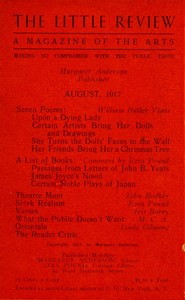
The Little Review, August 1917 (Vol. 4, No. 4) by Various
Let's be clear: The Little Review, August 1917 is not a novel. It's a snapshot. Opening it is like stepping directly into the literary and artistic conversations of that specific summer. You're not following a linear plot, but rather experiencing a curated collection of voices all reacting to their world.
The Story
There is no single story here, but there is a powerful collective mood. You'll find poems that ditch traditional rhyme and meter, stretching language in new ways. The short stories often focus on internal states—loneliness, artistic frustration, the disconnect between people—rather than big action sequences. Interspersed are illustrations and critiques that argue passionately for new forms of expression. The 'narrative' is the issue itself, documenting the vibrant, sometimes chaotic, birth of literary modernism in America. It's the sound of a culture trying to redefine itself in real-time.
Why You Should Read It
I loved it for its raw energy. These pieces weren't written to be classics; they were written to be now. Reading Ezra Pound's contributions or the quirky short fiction, you get the thrill of the new. It's also incredibly grounding for any modern creative. The struggles these writers faced—feeling misunderstood, pushing against tradition, finding beauty in fragmentation—are timeless. It reminds you that every era thinks it's uniquely chaotic, and art is always there, trying to make sense of it.
Final Verdict
This is for the curious reader, not someone looking for a easy, page-turning plot. It's perfect for history buffs who want to go beyond textbooks, for writers and artists seeking inspiration from the source, and for anyone who enjoys the feeling of discovering something truly original. If you've ever wondered what the 'modernist' fuss was all about, this is your chance to read it as it first appeared, without any historical polish. Approach it like an archaeological dig for ideas, and you'll be richly rewarded.
You are viewing a work that belongs to the global public domain. Knowledge should be free and accessible.
Margaret Brown
2 years agoGood quality content.
Thomas Davis
11 months agoUnlike many other resources I've purchased before, the breakdown of complex theories into digestible segments is masterfully done. Definitely a five-star contribution to the field.