
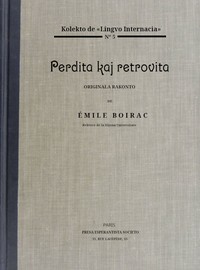
Perdita kaj retrovita : originala rakonto by Emile Boirac
I stumbled upon this book almost by accident, and I'm so glad I did. Written in Esperanto by French philosopher Émile Boirac, it's a hidden gem that feels surprisingly modern for being over a century old. Let's talk about what makes it so interesting.
The Story
The narrator is an ordinary man whose life gets turned upside down by his dreams. Night after night, he doesn't just dream—he wakes up in another city, with another name, another job, and another set of friends. This isn't a jumble of images; it's a parallel life that progresses logically from one sleep to the next. The boundary between his two worlds begins to crack when, during his waking hours, he meets strangers who claim to know him from his 'dream' city. The central mystery isn't about ghosts or magic; it's about the solidity of his own identity. Which life is the real one? Can both be true? The plot moves quickly as he tries to find proof, leading to a conclusion that is both satisfying and wonderfully open to interpretation.
Why You Should Read It
What grabbed me wasn't just the clever premise, but the quiet, psychological unease it creates. Boirac doesn't need special effects. The horror (and it is a bit horrific) comes from the slow-motion collapse of everything the narrator thinks he knows. You feel his confusion and desperation as he tries to convince others of what's happening. It's a story about the fragility of memory and the stories we tell ourselves to make sense of the world. Reading it made me think about my own recurring dreams and the strange sense of familiarity we sometimes get in new places. It's that kind of book—it gets under your skin and makes you wonder.
Final Verdict
This is a perfect pick for readers who love a smart, philosophical puzzle. If you enjoyed the reality-bending feel of stories like 'The Lathe of Heaven' or the movie 'Inception,' you'll find a fascinating ancestor here. It's also a great, accessible entry point into classic speculative fiction. Because it's short and the concept is so gripping, it's hard to put down. Fair warning: it was originally written in Esperanto, so you'll be reading a translation, but a good one preserves the clear, thoughtful tone. Don't expect action-packed scenes; expect a slow-burn, cerebral adventure that will haunt you long after the last page. A truly unique find from the history of weird fiction.
This book is widely considered to be in the public domain. You can copy, modify, and distribute it freely.
Robert Rodriguez
3 months agoHaving read the author's previous works, the way it challenges the status quo is both daring and well-supported. This should be on the reading list of every serious professional.
Brian Perez
4 months agoWow.
Donna Perez
1 year agoVery helpful, thanks.
Daniel Gonzalez
11 months agoPerfect.


Christopher Perez
2 months agoI started reading this with a critical mind, the data points used to support the main thesis are quite robust. Definitely a five-star contribution to the field.