
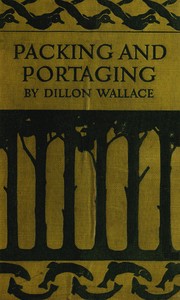
Packing and Portaging by Dillon Wallace
Dillon Wallace's Packing and Portaging is the true story of a promise that almost broke him. In 1903, his friend and fellow explorer Leonidas Hubbard died on a failed expedition to cross the interior of Labrador. With Hubbard's last words ringing in his ears, Wallace vowed to return and complete the journey. This book is his firsthand report from that second, grueling attempt.
The Story
The plot is straightforward in goal but agonizing in execution. Wallace, with a new partner named George Elson, heads back into the same unforgiving wilderness. The book walks you through every grueling step: packing impossible loads, fighting through endless swarms of blackflies, canoeing treacherous rivers, and facing constant hunger. The real tension isn't from a fictional villain, but from the land itself—a vast, indifferent opponent. Wallace's narrative is punctuated by memories of Hubbard, making the journey a physical and emotional ordeal. It's a slow, relentless push against exhaustion and doubt, where success is measured mile by painful mile.
Why You Should Read It
Forget glossy, heroic adventure tales. This book's power is in its plain-spoken honesty. Wallace isn't trying to be a hero; he's a man trying to outlast his guilt and grief. You feel the ache in his muscles, the chill of wet clothes, and the mental fog of hunger. His writing pulls you into the grind of survival in a way that feels immediate and real. It’s also a fascinating look at early 20th-century exploration, done without GPS or satellite phones. The relationship between Wallace and Elson, a guide of Cree heritage, adds a crucial layer, showing a deep reliance and respect that transcends the era's typical norms.
Final Verdict
This is a perfect pick for readers who love true survival stories like Into the Wild or Endurance, but want something with a quieter, more reflective pulse. It's for anyone interested in the history of exploration, the psychology of grief, or simply what it means to be stubborn enough to finish what you started. If you prefer fast-paced plots with clear villains, you might find the pace slow. But if you want to feel the weight of a backpack, the chill of a Labrador river, and the heavy burden of a promise, Dillon Wallace will take you there.
This publication is available for unrestricted use. Use this text in your own projects freely.
Michael Thomas
2 years agoThe methodology used in this work is academically sound.
Dorothy Wright
1 year agoThanks for the recommendation.
Noah Lee
1 year agoClear and concise.
Margaret Wilson
5 months agoVery helpful, thanks.








Karen Johnson
8 months agoThe clarity of the concluding remarks is very professional.