
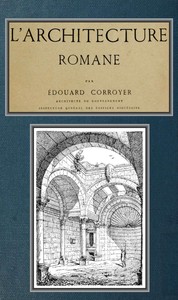
L'Architecture romane by Édouard Corroyer
Édouard Corroyer's L'Architecture romane is a fascinating journey back to the roots of medieval European building. Written in the 19th century, it captures a moment when people were just beginning to appreciate these ancient structures for their own unique beauty, rather than seeing them as primitive versions of something better.
The Story
This isn't a novel with a plot, but the 'story' is how Corroyer makes a compelling case for Romanesque architecture. He walks you through the defining features: the massive, fortress-like walls, the semi-circular arches, and the compact, grounded plans. He explains the engineering—how builders used stone vaults to create fireproof ceilings, leading to those characteristic thick pillars. He shows how every element, from the placement of windows to the carving on a capital, served a purpose. The narrative is his passionate argument that this style wasn't a mistake or a lack of skill, but a deliberate and powerful form of artistic and spiritual expression that dominated Europe for centuries.
Why You Should Read It
What makes this book special is Corroyer's genuine enthusiasm. You can tell he's not just a scholar in a library; he's been out there, touching the stones, sketching the layouts, and feeling the atmosphere of these places. His writing helps you see with new eyes. After reading it, you'll walk into a Romanesque church and notice the intentional weight of the space, the way the light slants in, and the raw power of the construction. It turns a sightseeing trip into a much richer experience. He connects the architecture to the society that built it—a world focused on faith, community, and defense.
Final Verdict
This is the perfect book for a curious traveler, an art history beginner, or anyone who loves old buildings and wants to understand them better. It's not a light, modern guidebook; it's a foundational text written with clarity and heart. If you're planning a trip to places like Provence, Burgundy, or the pilgrimage routes of France and Spain, reading Corroyer will transform your visit. You'll move from simply taking photos to truly seeing the genius in the stone.
This content is free to share and distribute. You are welcome to share this with anyone.
Linda Martin
6 months agoI decided to give this a try based on a colleague's recommendation, it addresses the common misconceptions in a very professional manner. I’ll definitely be revisiting some of these chapters again soon.
Margaret Thompson
10 months agoThis was exactly the kind of deep dive I was searching for, the nuanced approach to the central theme was better than I expected. I'll be recommending this to my students and colleagues alike.
Matthew Lopez
1 year agoHaving followed this topic for years, I can say that the level of detail in the second half of the book is truly impressive. It definitely lives up to the reputation of the publisher.
Joseph Perez
9 months agoThe analytical framework presented is both innovative and robust.







Richard Hernandez
8 months agoIt effectively synthesizes complex ideas into a coherent whole.