
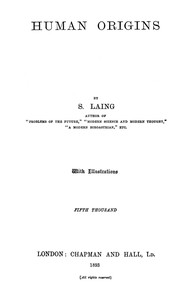
Human Origins by S. Laing
Published in 1892, Samuel Laing's Human Origins isn't a modern textbook. It's a snapshot of a brilliant mind grappling with the ancient past using the science of the Victorian era. Laing takes his reader on a journey, starting with the formation of the Earth and the earliest signs of life. He pieces together the story of human development from geological strata, fossil finds (which were scarce back then), and comparisons with existing cultures he considered 'primitive.'
The Story
The plot here is the plot of discovery. Laing lays out his evidence chapter by chapter, building a case for how humanity evolved physically and socially. He talks about ancient tools, burial sites, and the development of language and religion. A big part of the narrative is his argument against other popular theories of his time, especially those that relied more on religious doctrine than physical evidence. He's trying to push a scientific, reason-based view of our deep history, which was a pretty bold move for the period. You follow his logic as he connects dots from bone fragments to the dawn of societies.
Why You Should Read It
You don't read this for up-to-date facts. You read it for the perspective. It's thrilling and humbling to see how a sharp thinker like Laing navigated the unknown. His conclusions are sometimes startlingly prescient and other times completely off-base by today's standards, which is exactly what makes it so compelling. It makes you appreciate the slow, cumulative nature of science. You also get a strong sense of Laing's personality—he's confident, sometimes dismissive of rivals, and filled with genuine wonder at the story he's uncovering. It’s a reminder that our current understanding was hard-won.
Final Verdict
This book is perfect for history buffs, science enthusiasts, and anyone who loves seeing how ideas change over time. If you enjoy books like The Invention of Nature or are fascinated by the history of scientific thought, you'll find Laing's work incredibly engaging. It's not for someone seeking a straightforward, factual account of human evolution. But if you want to spend time inside the mind of a Victorian intellectual on a grand quest for answers, Human Origins is a unique and thought-provoking time capsule.
This historical work is free of copyright protections. Access is open to everyone around the world.
Barbara Johnson
1 year agoGiven the current trends in this field, the nuanced approach to the central theme was better than I expected. A trustworthy resource that I'll keep in my digital library.
James Miller
1 year agoThe balance between academic rigor and readability is perfect.
Donald Lee
5 months agoThis was exactly the kind of deep dive I was searching for, the breakdown of complex theories into digestible segments is masterfully done. This has become my go-to guide for this specific topic.
Christopher Davis
1 year agoThis digital copy caught my eye due to its reputation, it manages to maintain a consistent flow even when discussing difficult topics. I'm glad I chose this over the other alternatives.




John Martinez
1 month agoInitially, I was looking for a specific answer, but it addresses the common misconceptions in a very professional manner. Definitely a five-star contribution to the field.