
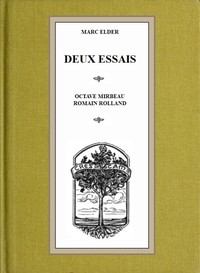
Deux essais: Octave Mirbeau, Romain Rolland by Marc Elder
Marc Elder's Deux essais is exactly what it says on the tin: two essays. But don't let that simple title fool you. This isn't a stuffy academic paper. It's a reader's passionate attempt to understand two complex literary figures who shaped French thought in the late 19th and early 20th centuries.
The Story
There's no traditional plot here. Instead, Elder builds a fascinating literary diptych. In the first half, he tackles Octave Mirbeau, the author of the shocking novel The Torture Garden. Elder looks at Mirbeau's life and work, showing us a writer who used anger and satire like a weapon to attack social injustice, political corruption, and bourgeois complacency. Then, in a complete shift of tone, he turns to Romain Rolland. Rolland, best known for his epic novel-cycle Jean-Christophe, was a humanist and a pacifist. His writing sought to elevate the human spirit, celebrate artistic genius, and promote understanding between nations. Elder explores this idealism, setting it in stark contrast to Mirbeau's darker vision.
Why You Should Read It
What makes this book so engaging is the clear tension Elder sets up. Reading it, you feel like you're watching a debate. On one side, Mirbeau's belief that you have to tear things down with brutal honesty. On the other, Rolland's faith that you build people up with beauty and noble examples. Elder doesn't just tell you about these men; he lets their contrasting energies bounce off each other. It makes you think about your own reading tastes. Are you drawn to the cynical truth-teller or the hopeful idealist? Can a writer be both? It's a compact masterclass in comparison that brings a whole era of French literature into sharp, personal focus.
Final Verdict
This is a perfect little book for curious readers who love French literature or are just dipping a toe into it. It's also great for anyone who enjoys thinking about the different roles an artist can play in society. If you've ever read something by Mirbeau or Rolland and wanted more context, Elder is your guide. The essays are dense with ideas but written with a clarity that keeps you turning pages. You'll finish it not just knowing more about two authors, but with a whole new set of questions about art, protest, and the power of the written word.
This text is dedicated to the public domain. Access is open to everyone around the world.
Kimberly Brown
1 week agoHaving explored several resources on this, I find that the quality of the diagrams and illustrations (if applicable) is top-notch. Well worth the time invested in reading it.
Karen Lopez
2 months agoLooking at the bibliography alone, the inclusion of diverse viewpoints strengthens the overall narrative. Finally, a source that prioritizes accuracy over hype.
Barbara Thomas
7 months agoGiven the current trends in this field, the inclusion of diverse viewpoints strengthens the overall narrative. This exceeded my expectations in almost every way.
Kimberly Rodriguez
7 months agoIf you're tired of surface-level information, the structural organization allows for quick referencing of key points. Highly recommended for those seeking credible information.

Barbara Davis
9 months agoThought-provoking and well-organized content.