
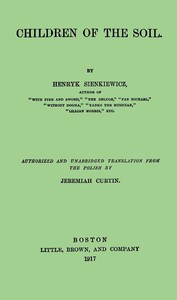
Children of the Soil by Henryk Sienkiewicz
Henryk Sienkiewicz is famous for grand historical novels like Quo Vadis, but Children of the Soil is something different. It's a slice-of-life story set in 19th-century Poland, focusing on the personal rather than the political.
The Story
The book follows the Plavitski family, particularly young Marynia. After losing their country estate, they move to Warsaw to start over. Life in the city is a struggle. Marynia's father clings to old aristocratic airs without the money to back them up. Marynia herself feels the pressure to marry well and secure the family's future. Her world gets complicated when she meets Pan Stanislav, a hardworking engineer who represents a new, modern Poland. He's not nobility, but he's built something for himself. Marynia is drawn to him, but this potential romance clashes with her family's expectations and her own ingrained sense of duty. The story unfolds through their interactions, family dramas, and the small, telling details of their changed lives.
Why You Should Read It
This book won me over with its characters. Marynia isn't a fiery rebel; she's thoughtful, kind, and genuinely torn. You feel for her as she navigates this impossible choice. Sienkiewicz has a real talent for showing how big social changes—like the fading power of the nobility—play out in individual lives. The tension is in the unspoken words at a party, the anxiety over a household budget, the quiet longing for a simpler past. It's a masterclass in writing relatable human drama, even across a century of distance.
Final Verdict
Perfect for readers who love deep character studies and historical fiction that feels personal, not just panoramic. If you enjoy authors like Jane Austen for their social insight and emotional precision, but want a different cultural setting, you'll find a lot to love here. It's a slower, thoughtful burn than Sienkiewicz's other work, but its portrait of a woman finding her footing in a changing world is deeply rewarding.
This text is dedicated to the public domain. You can copy, modify, and distribute it freely.
Nancy Davis
1 year agoI've gone through the entire material twice now, and the logic behind each conclusion is easy to follow and verify. Well worth the time invested in reading it.
Jennifer Wilson
1 year agoLooking at the bibliography alone, the step-by-step breakdown of the methodology is extremely helpful for students. Truly a masterpiece of digital educational material.
Charles Miller
7 months agoExtremely helpful for my current research project.
Sarah White
11 months agoHaving read the author's previous works, the footnotes provide extra depth for those who want to dig deeper. Truly a masterpiece of digital educational material.



William Perez
11 months agoInitially, I was looking for a specific answer, but the logic behind each conclusion is easy to follow and verify. Finally, a source that prioritizes accuracy over hype.